25 November 2026 · 15 min read
Who's really paying for the AI buildout?
The companies building AI used to pay for it from their own cash. In 2026 they spent more than they earned and borrowed $304bn to keep going.
 Ray KamedaCo-Founder & Chief Product Officer
I build with AI every day. It writes code with me and helps our small team at Beetl build far more than we could alone.
Like many of you, I've also watched the money around AI get bigger than anything I'd seen. In June, SpaceX, which now owns xAI, listed on the stock market at $1.77tn, the largest listing ever. Last week Anthropic, which makes the Claude models I use every day, listed at $1.76tn. The headlines call it a bubble one day and a revolution the next.
So I set out to follow the data, without the hype and without the doom, and understand how the money underneath works. Who pays, who borrows, and who is left holding the bill if it stops?
In 2019, Microsoft, Alphabet, Amazon, Meta and Oracle spent 36 cents on new buildings and equipment for every dollar their businesses brought in. In the first 9 months of 2026, the same 5 plus CoreWeave spent $1.06. The AI buildout now costs more than the companies doing it earn. For a household, that's putting more than your whole take-home pay into the house.
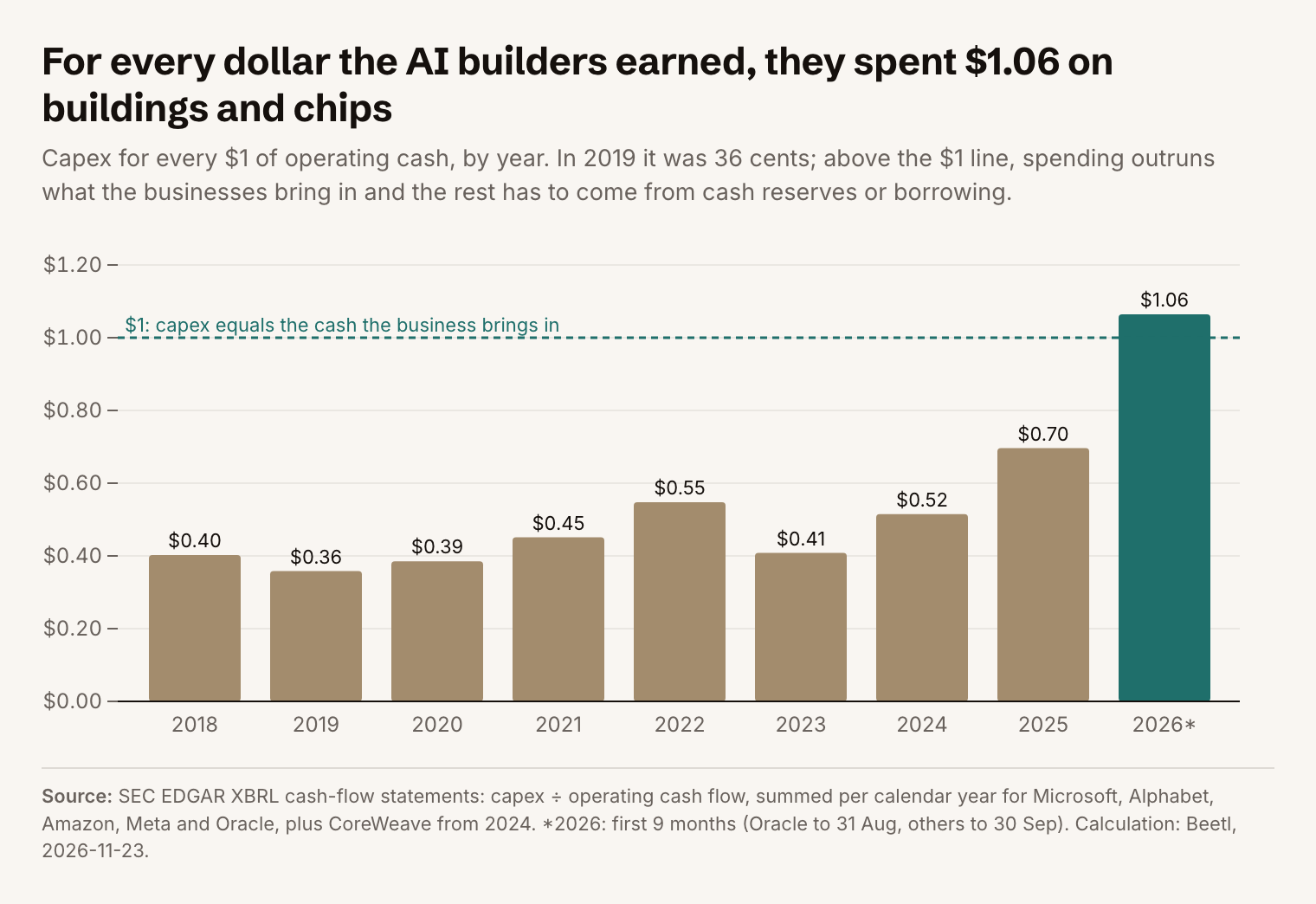
So where does the rest come from? I spent the last week digging through these companies' cash flow statements, debt schedules and footnotes. The short answer: lenders.
This is part 1 of 3, and it follows the money in 5 steps:
- how spending outgrew the cash
- who lent the difference
- the debt you can't see
- where it all leads
- why borrowing speeds the boom up
Part 2 asks whether the lenders are worried, and Part 3 who loses if they are. All 3 parts come with a live tracker that updates as new filings land.
Spending outgrew the cash
Capex is the baker's new oven
Think of the bakery in your neighborhood. Mine is a Bäckerei in Berlin. Its new oven is capex, short for capital expenditure, meaning money spent on things that last for years. What's left from selling bread rolls, after paying for flour and wages, is its operating cash flow. A careful baker buys ovens out of that cash and would rather not owe the bank a cent. The AI builders work the same way, only their ovens are data centers, power lines and chips.
One purchase feeds the next
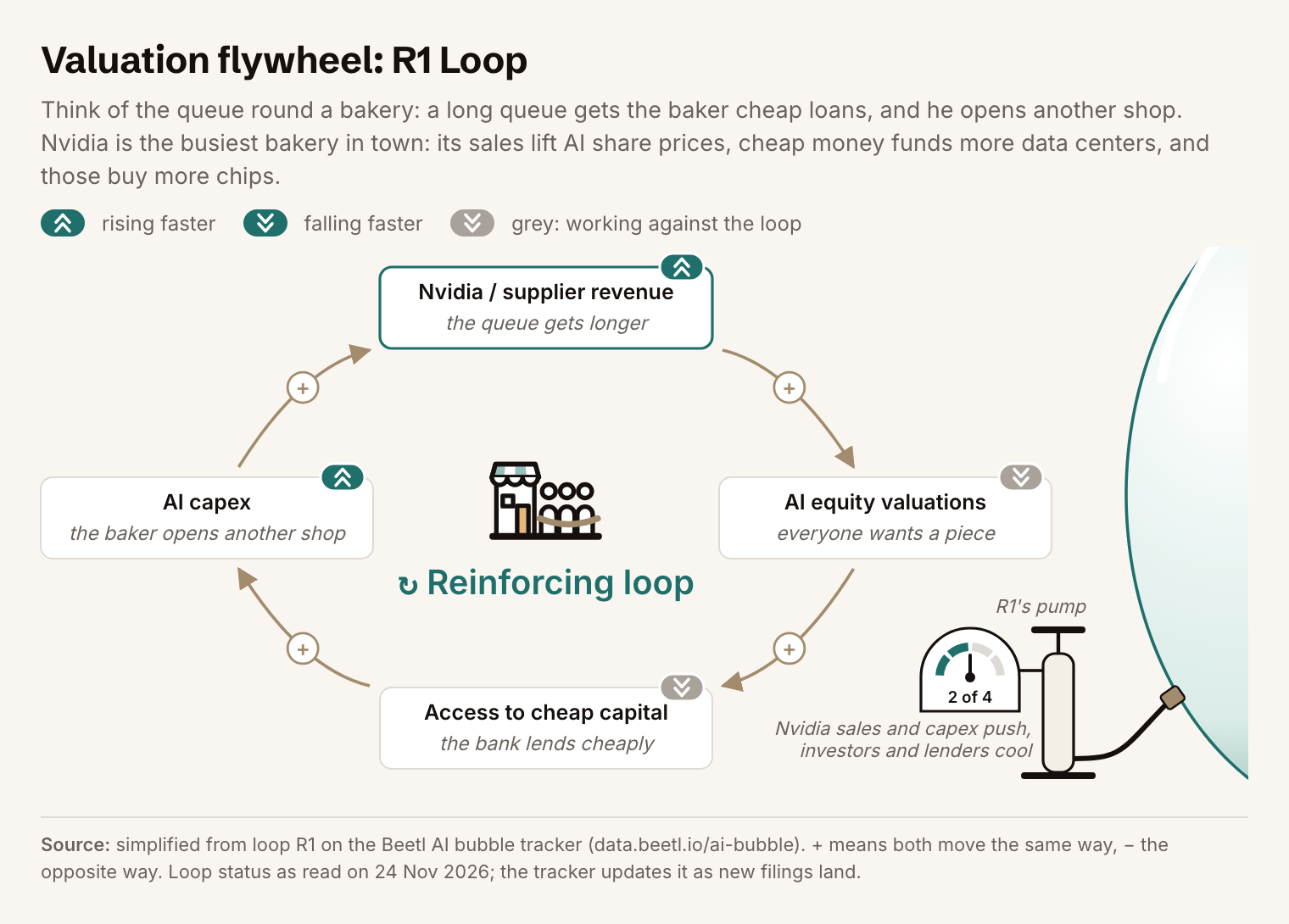
Now take one purchase. Microsoft buys a rack of Nvidia chips. That's capex for Microsoft and income for Nvidia. Nvidia's higher income lifts its share price, which makes investors keener to fund everyone in AI, which pays for the next rack. That profitable loop has driven AI since 2023. Think of the queue round my bakery. A long queue makes it look like a goldmine, the bank lends cheaply, the baker opens another shop, and the queue grows again. Nvidia is the busiest bakery in town. On the tracker it's R1, the valuation flywheel, a reinforcing loop — each turn makes the next one bigger. The tracker also maps balancing loops, which brake harder the faster the boom runs. We'll meet 2 of each in this post.
The builders now spend more than they make
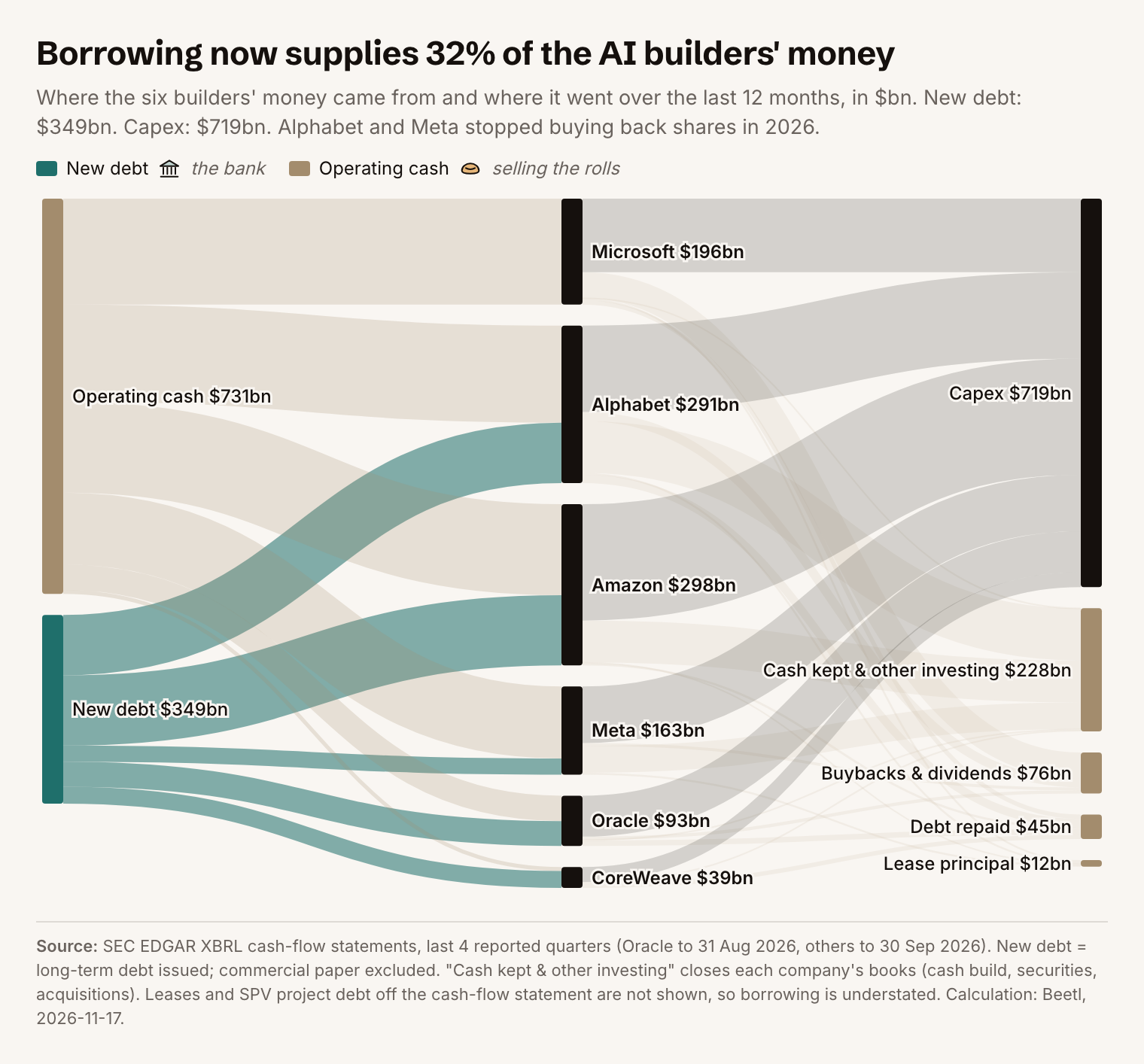
For most of that time, it ran on the builders' own cash. Until 2024 they spent about half of what their businesses brought in on capex. Then spending grew faster than income. In the 12 months to September, the 6 spent $719bn on capex against $731bn of operating cash. After paying shareholders, that left a massive hole.
Lenders filled the gap
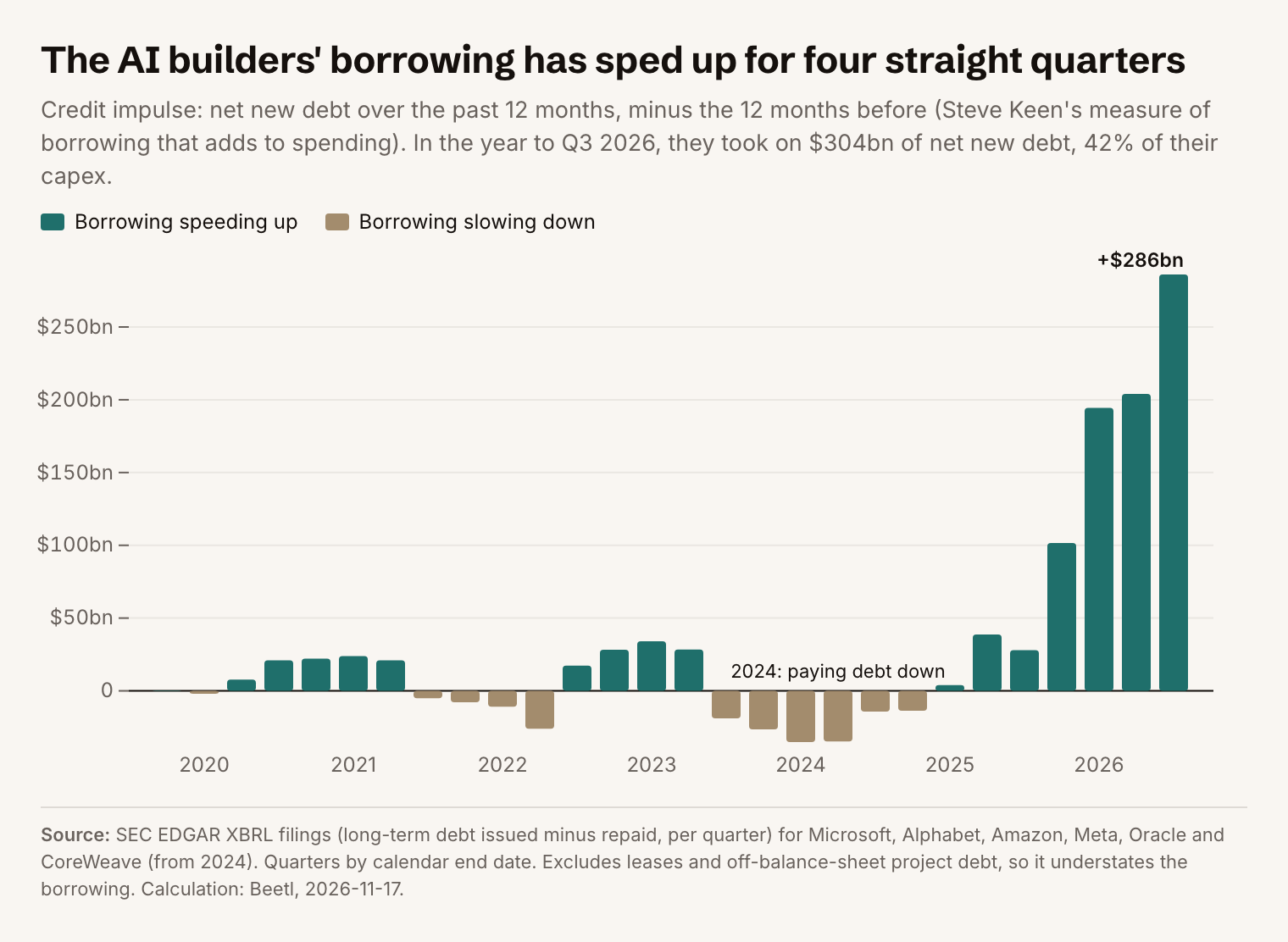
Debt grew by $304bn in a year
My baker would have waited a year for the second oven. The builders borrowed. Over those 12 months the 6 borrowed $349bn and paid back $45bn, so their debt grew by $304bn, enough to cover 42% of their capex. A year earlier it grew by $18bn. It hasn't slowed since. On 29 October Microsoft sold $25bn of bonds, its first since 2017, and within a week Oracle added $10bn and Meta $15bn.
Why not wait? Nobody wanted to fall behind. Mark Zuckerberg said he would rather risk "misspending a couple of hundred billion" than be late to superintelligence. Their cash was already stretched. In the first 9 months of 2026, Microsoft, Alphabet, Amazon, Meta and Oracle cut their share buybacks by 83%, to $13.6bn, and still paid $37bn in dividends. Lenders were happy to fill the gap, because pension funds and insurers want long-dated bonds, and these paid about 5%.
Not every borrower is equally safe
Who borrowed matters more than the total. Microsoft borrowed nothing, at least until October. Alphabet ($97bn) and Amazon ($126bn) borrowed a lot, but they are among the safest borrowers in the world.
Oracle and CoreWeave are weaker. Oracle owes $125bn, and since July S&P has rated its debt 1 step above "junk". CoreWeave, a "neocloud" that rents out AI chips, saw its debt go from $21bn to $47bn in 9 months. In the third quarter it paid $846m in interest while its business earned $207m.
The economist Hyman Minsky sorted borrowers into 3 kinds:
| Kind | Like a household that… | Who's there now |
|---|---|---|
| Hedge | pays its mortgage from its salary | Microsoft, Meta |
| Speculative | can pay the interest, but needs a new loan when the old one is due | Oracle, Amazon |
| Ponzi | can't pay the interest, so borrows to pay it | CoreWeave |
"Ponzi" is Minsky's tongue-in-cheek label for how a borrower is funded, not a claim of fraud.
The first brake: debt payments
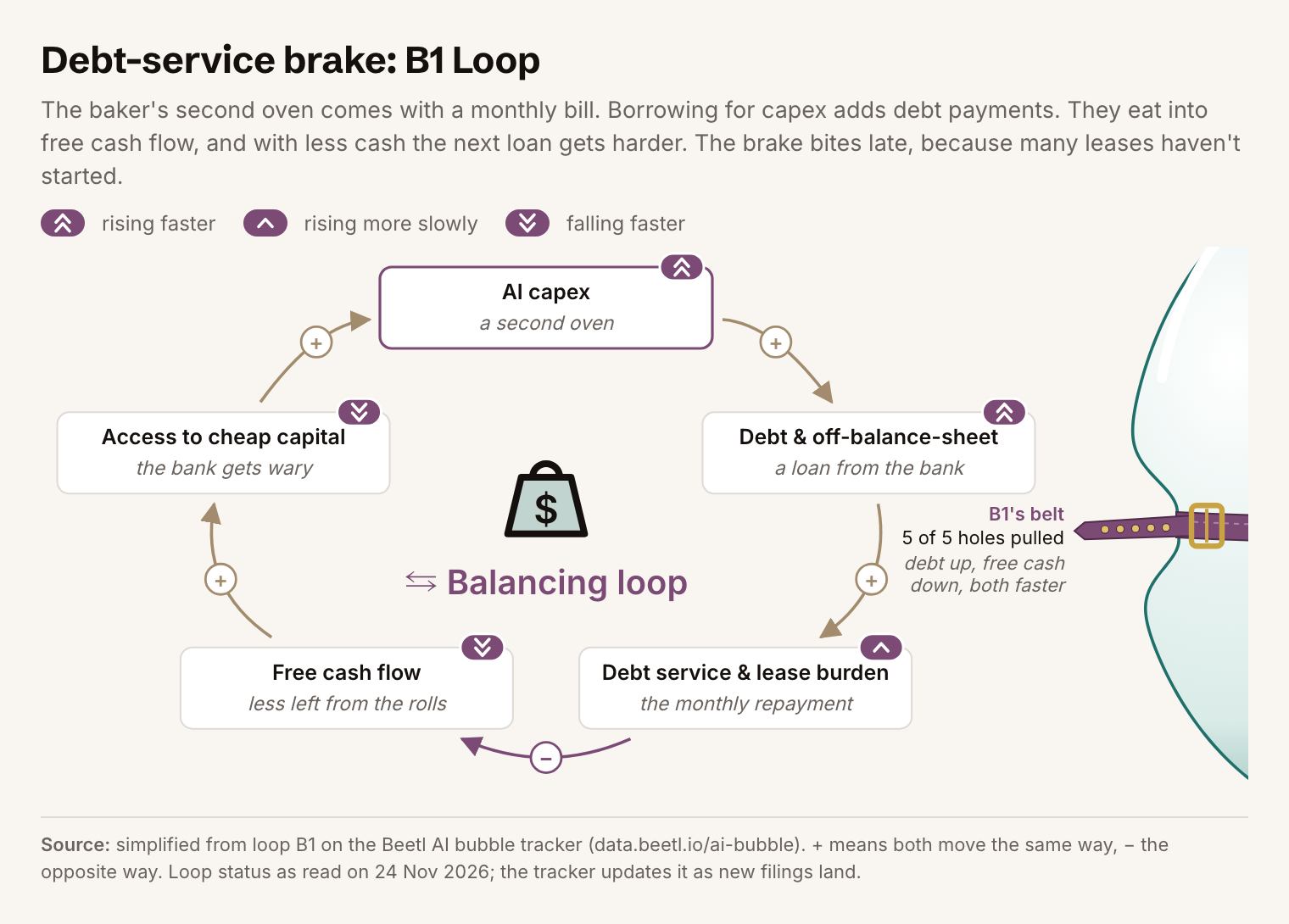
All this borrowing feeds the first brake, B1, the debt-service brake. More capex means more debt, debt payments eat into free cash flow, and less cash makes the next loan harder to get. It bites late, because much of what the builders owe hasn't come due yet. All 5 of its live readings show it tightening.
The debt you can't see
The $304bn is the debt on the companies' own books. A lot of the buildout is paid for somewhere else.
Leases that haven't started yet
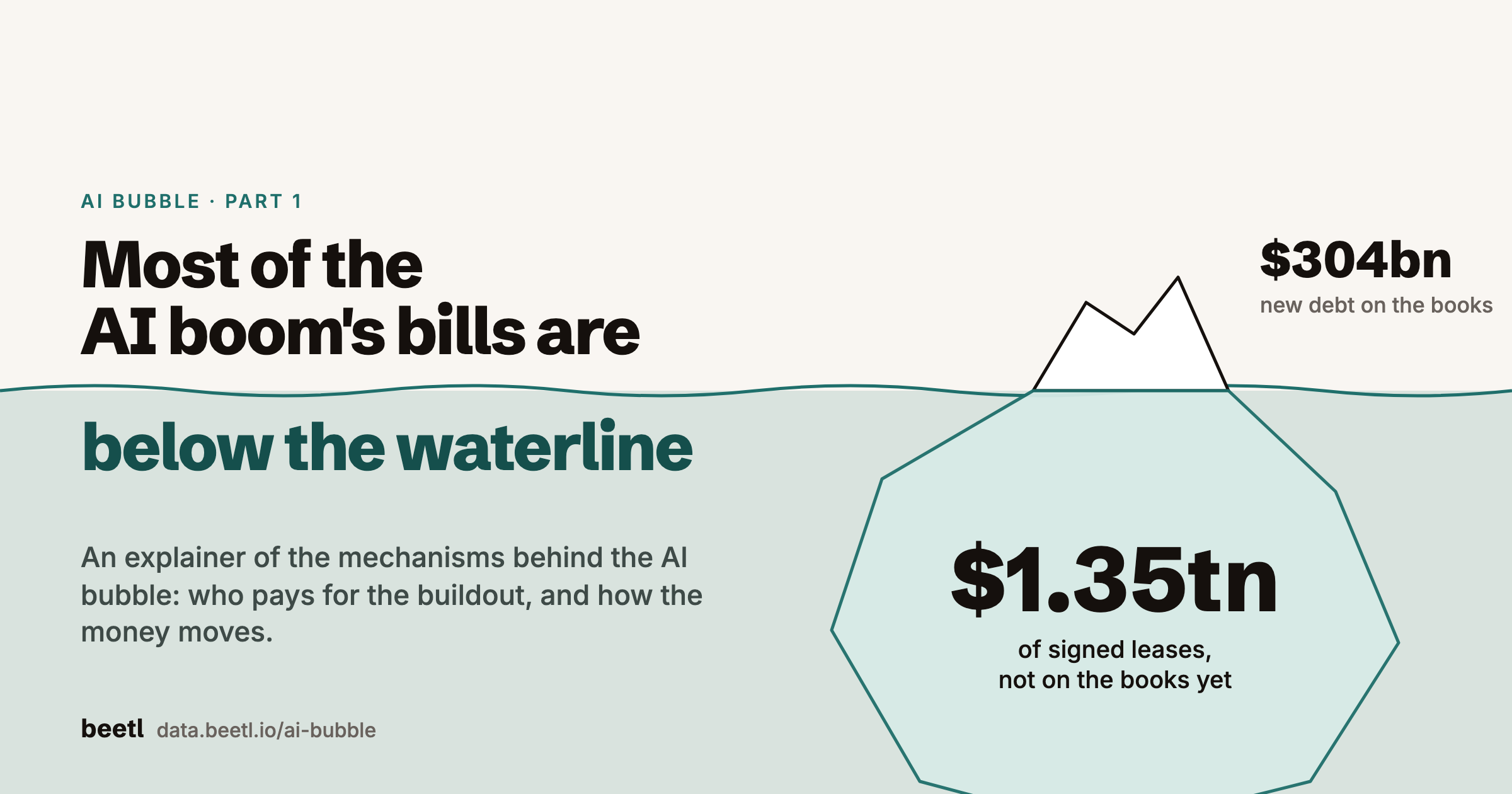
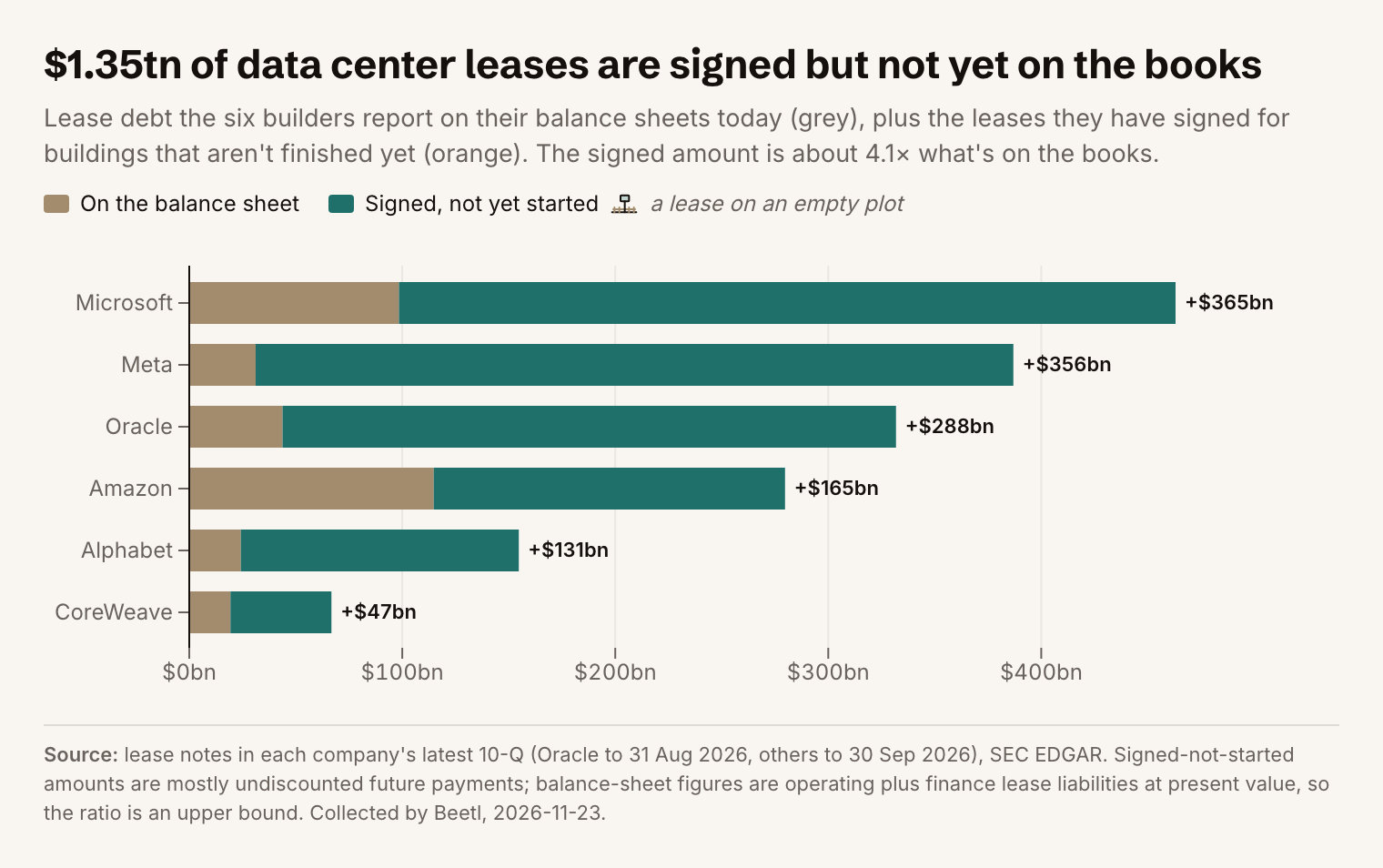
The biggest piece is leases. Instead of building a data center itself, a tech giant can sign a 15-year rental agreement on one a developer hasn't built yet. The developer then borrows against that agreement to build it. For the bakery, it's like signing a 15-year lease on a second shop in a building that's still an empty plot, so the landlord can get a loan to build it. The beauty of this is that until the building is finished, the rent doesn't count as debt on the tech giant's closely monitored balance sheets.
It sits in the lease notes near the back of each quarterly filing, where few people look. Added up, the 6 builders have signed $1.35tn of leases that haven't started yet, about 4 times the lease debt on their balance sheets today. Microsoft alone has $365bn of them and Meta $356bn.
Project companies keep debt off the books
The second piece is separate companies set up for a single project. Meta's $27.3bn Hyperion bond, for its Louisiana data center, was issued by one, so on paper the debt isn't Meta's. So the $304bn on the books is only the floor. The real share paid with borrowed money is higher, and nobody publishes the full number.
It all leads to the labs
Nvidia backs its own customers
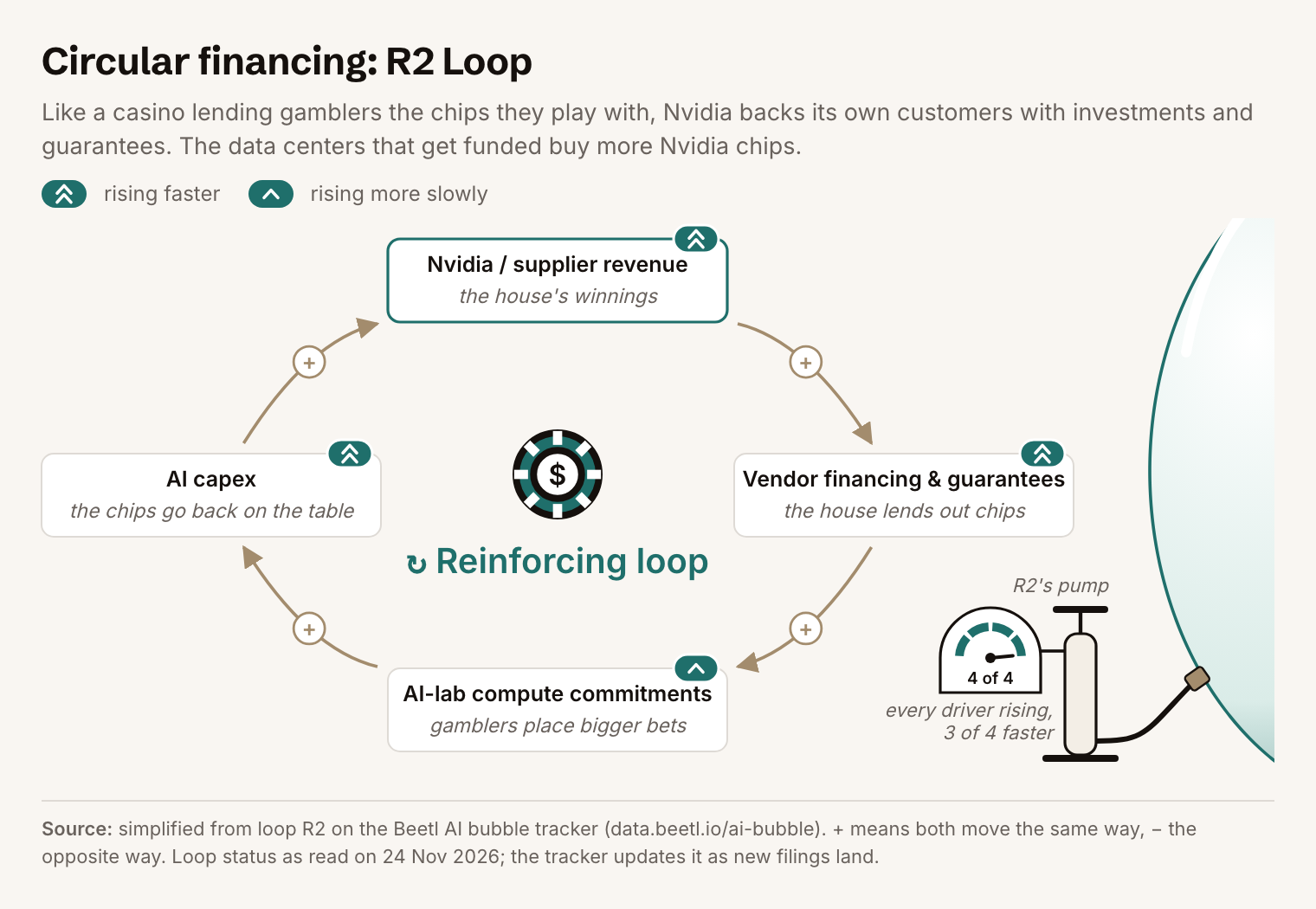
Follow the riskier borrowers and you find their biggest supplier standing behind them. Nvidia's famous "up to $100bn" for OpenAI never closed; it became a $30bn investment. What grew instead are guarantees. Nvidia has promised to cover $108.5bn of lease payments, mainly on OpenAI's Ohio data center, if the tenant can't pay. It has also promised up to $125bn of backing for a lending platform run with Apollo, BlackRock and Blackstone.
That is vendor financing, a seller helping its customer pay for what it sells. Nvidia's income backs a guarantee, the guarantee lets a data center get funded, and the data center buys more Nvidia chips. Think of a casino lending gamblers the chips they play with. It works as long as the gamblers keep winning. The guarantees only appear in the accounts if a tenant stops paying. Yes, I'm calling Nvidia a casino with lots of chips to sell. On the tracker this is R2, circular financing, the second reinforcing loop. As of this writing, all 4 of its drivers are still pushing it faster.
These figures come from Nvidia's July quarterly report. The next one is late. Nvidia held it back after Jensen Huang stepped down as CEO on 12 November and its board opened an investigation. The board reinstated him on 23 November, but the investigation continues and the report is still missing. I guess Jensen and the board have a lot to flesh out before getting their quarterly report out!
The labs spend money they don't have yet
At the end of almost every chain sits an AI lab. Oracle's order book, CoreWeave's contracts and Nvidia's Ohio guarantee all lead to OpenAI. The labs have signed for computing power their revenue doesn't cover yet.
- Anthropic is well covered for now, with $98.2bn of cash against $73.5bn of bills due in 2027 and 2028, plus about $81bn from its November listing. The catch is the total it has signed for — about $901bn, most of it due after 2030.
- OpenAI is thin. It expects to burn about $278bn over 2026 to 2030, and this month has raised about $15bn of a round cut from $30bn to $20bn, at a lower valuation than it asked for. By my arithmetic, it will need new money by about 2029.
- SpaceX/xAI has $89.9bn of cash, 3 times what it owes in 2027 and 2028, but at this year's pace of capex that lasts about 2 years.
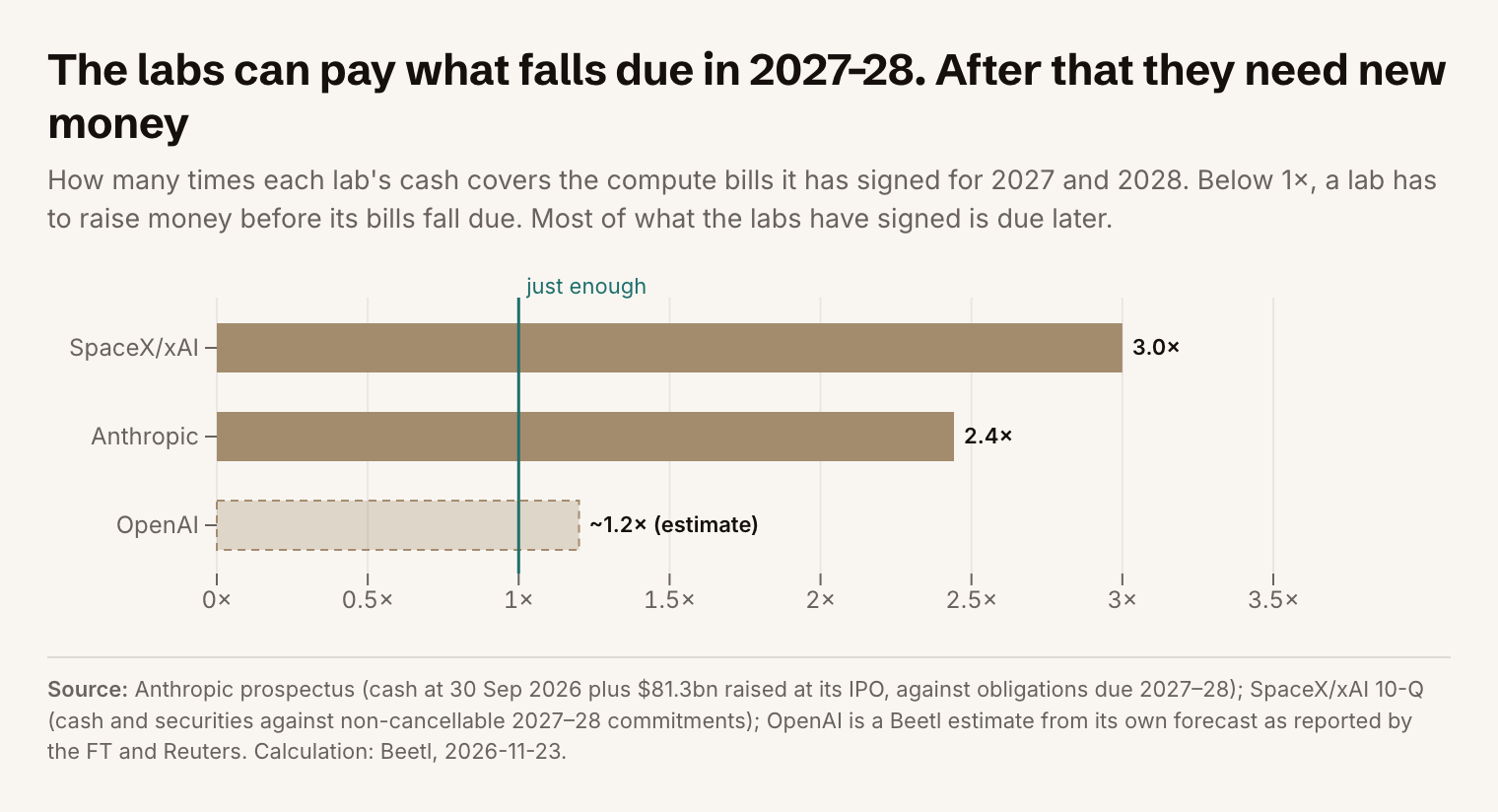
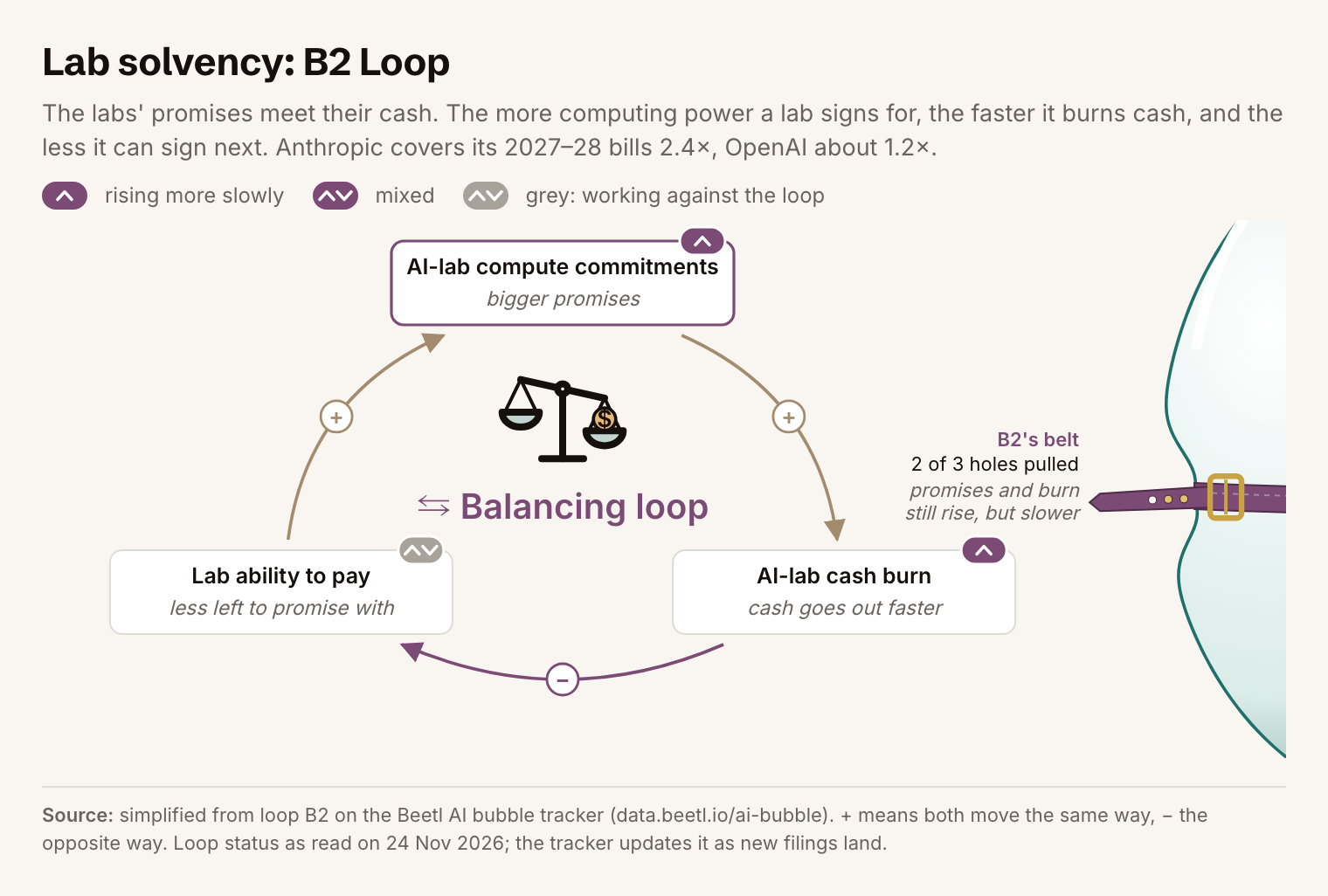
That makes the labs the hinge. The tech giants can stop spending and survive; the labs have promised money they haven't raised yet. They're also the second brake, B2 on the tracker. The more computing power a lab signs for, the faster it burns cash, and the less it can sign next. It's tightening too, but slower than B1.
Where the money lands
All of these promises become buildings. I mapped every US data center I could find from SUE Data Centers and Epoch AI, 2,169 sites that are running, being built or planned. The ones not yet built would draw 298 gigawatts of power. One gigawatt is about what a large nuclear reactor produces.
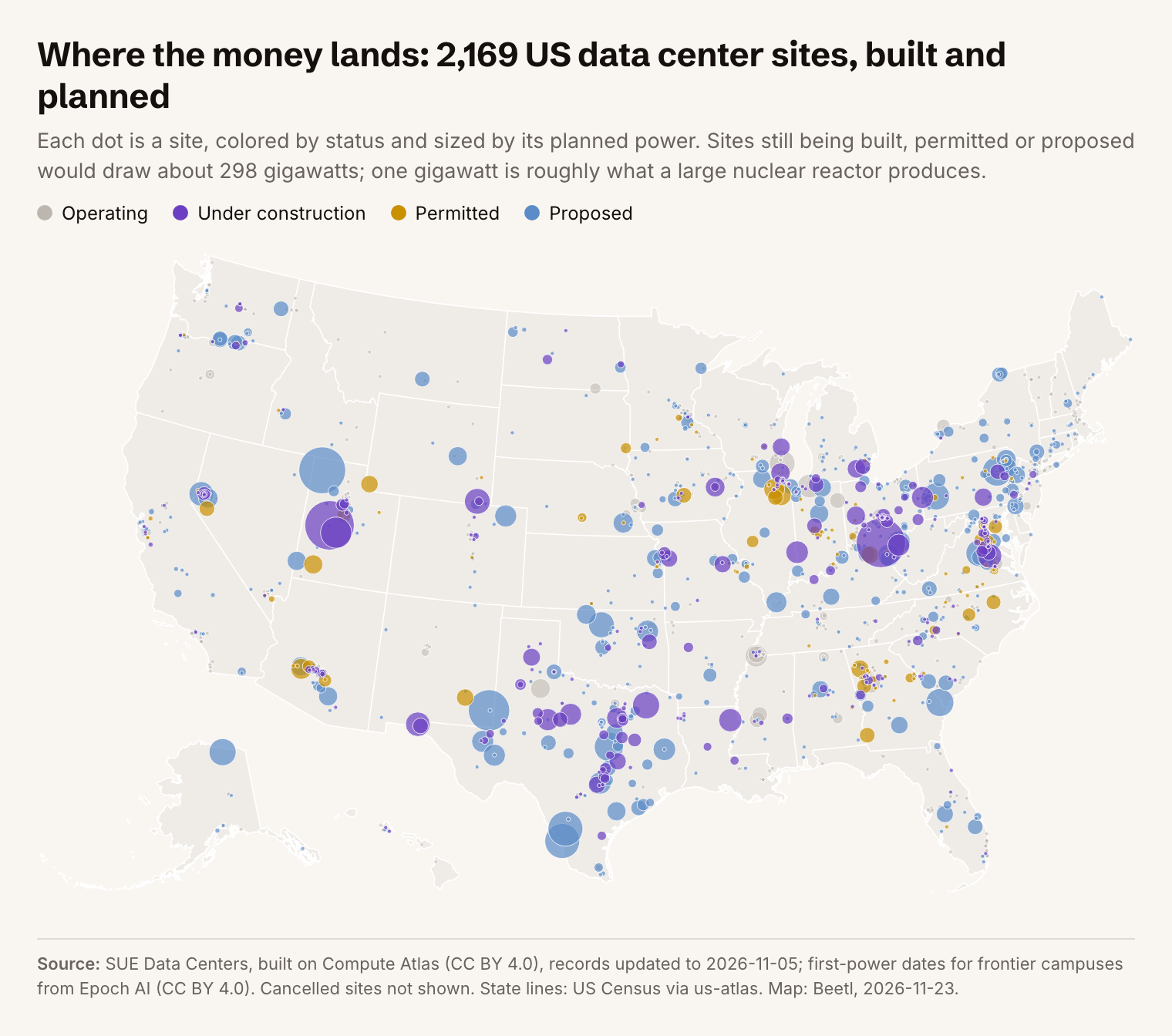
Take one of the big dots. Meta's Hyperion campus in Louisiana is large enough that Mark Zuckerberg compared its footprint to a large part of Manhattan. The building is paid for by the $27.3bn bond from a separate company, Meta pays for its use through a lease, and what goes inside is mostly Nvidia chips. Every big dot on the map is a stack like that, with a lease, a loan, a supplier's backing and, at the far end, a lab's promise to pay.
Borrowing speeds it up, and can slow it down
The change in borrowing drives spending
Why does it matter whether money is borrowed, if everyone pays it back? The economist Steve Keen, who warned of the 2008 crash, explains it with one rule: total spending equals income plus new borrowing. When banks lend, they create money that wasn't there before, and it gets spent.
That means what drives growth is the change in borrowing, which Keen calls the credit impulse. Back to the bakery. If it borrowed €10,000 for an oven last year and €30,000 this year, it has €20,000 more to spend this year, though it didn't sell a single extra bread roll. For the 6 builders, yearly borrowing rose by $286bn between Q3 2025 and Q3 2026, and it has sped up 4 quarters in a row. Debt is now what makes the buildout accelerate.
A small cut hurts the suppliers
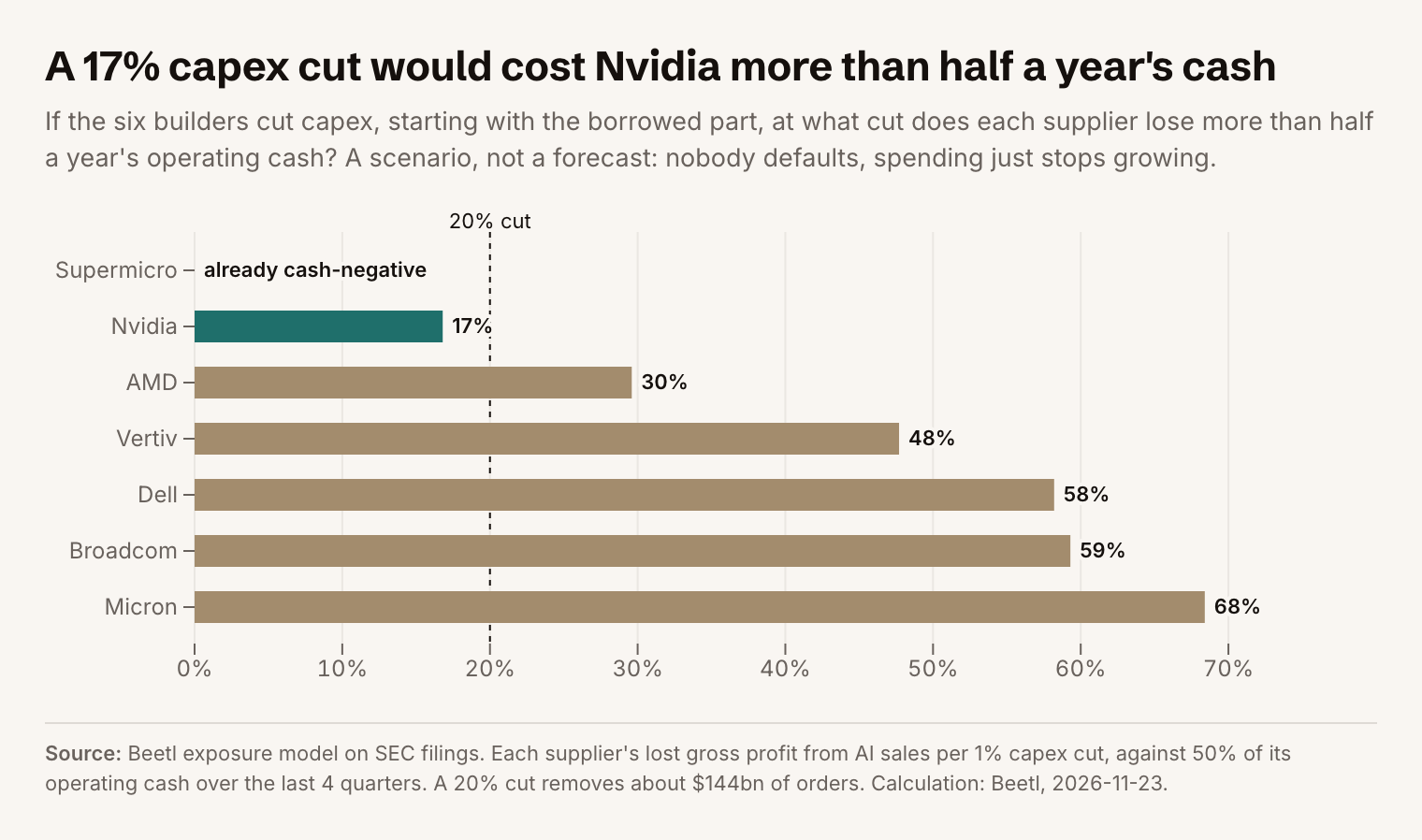
The same rule works in reverse. Spending falls as soon as borrowing stops growing, with nobody going bust. In my simplified model, if the builders cut capex by 20%, starting with the borrowed part, $144bn of orders disappear. Nvidia feels it most. Past a cut of about 17%, it loses more than half a year's cash. Leverage is a hell of a double-edged sword. R1 runs backwards too, with less spending, less Nvidia income, cooler investors and even less spending.
The pumps are still winning
Put the pieces together and the risk looks different from what I expected. Nobody has to go bust for this to hurt. Capex grew 96% in a year, yet a cut of just 17% would cost Nvidia more than half a year's cash.
And whichever thread I pull, it ends at the labs, OpenAI above all. A large part of the $1.35tn of signed leases, and of Nvidia's guarantees, rests on them raising their next round. If that round comes in smaller, as this month's did, the labs sign for less, capex stops growing, and the pumps slow while the belts keep tightening.
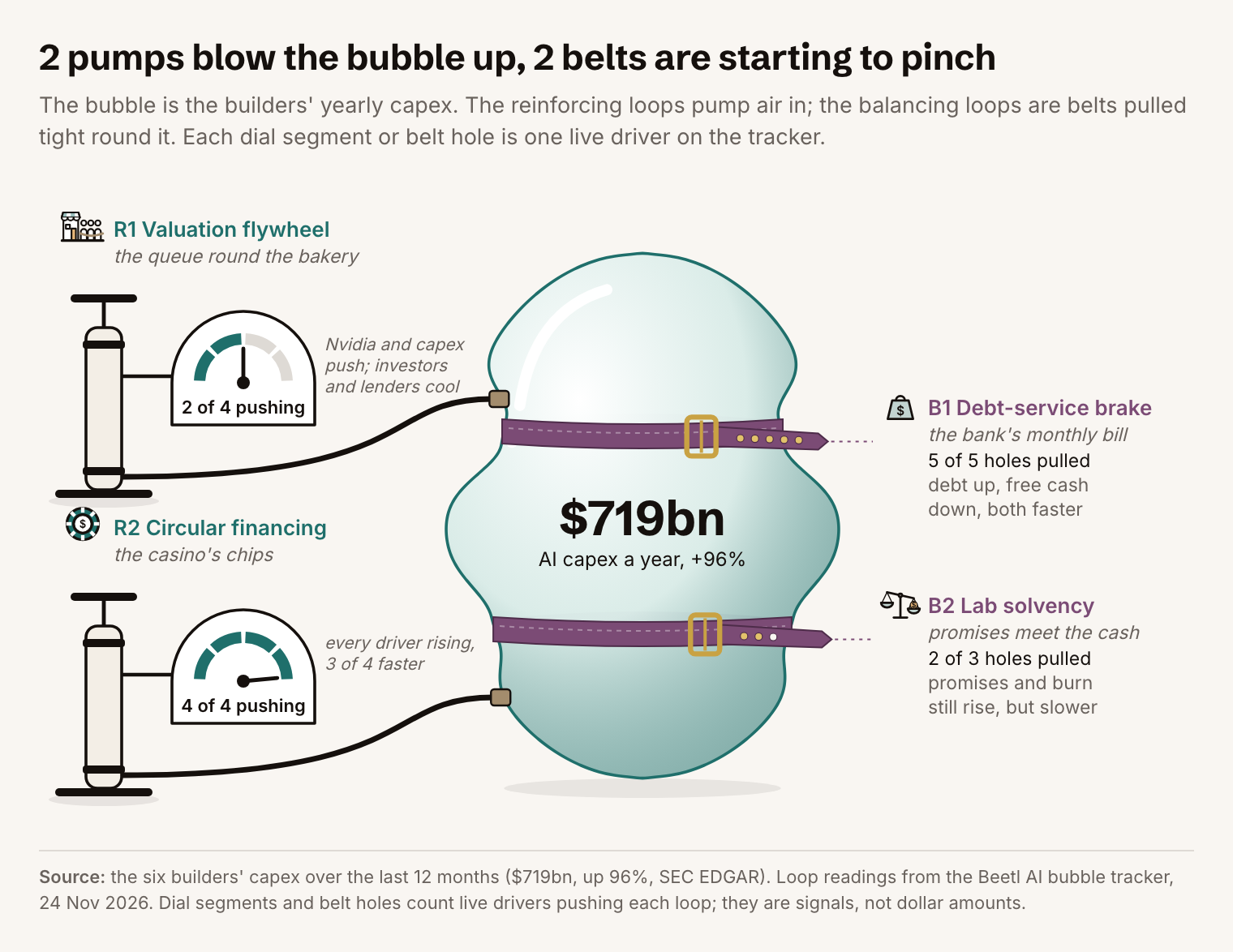
For now the pumps are winning, and the bubble is still growing. You can watch the balance shift on the tracker.
What comes next
AI can be worth building and still be financed badly. Railways and fiber both outlived the companies that went bust laying them. Steve Keen expects less to be left over this time. A chip falls behind in 3 or 4 years while railway track lasted for decades, and he jokes that some data centers will end up as "pickleball courts". What the filings show is narrower: the buildout used to be paid for with cash, and now a growing share is paid for with debt, much of it off the books and pointed at a few labs.
Debt like this is fine as long as lenders stay calm. Are they? That's Part 2.
How I did this
- Funding: SEC filings (XBRL cash flow statements) for 6 companies since 2018
- Leases: the lease notes in the same filings
- Labs: prospectuses and press reports
- Data center map: SUE Data Centers and Epoch AI (both CC BY 4.0)
As with my pieces on Germany's gas storage and the FAA ground stop, the data is collected and joined on Beetl, and the tracker reads the same outputs as this post.
FAQ
How much of AI spending is paid for with debt?
At least 42% in the 12 months to September 2026. Microsoft, Alphabet, Amazon, Meta, Oracle and CoreWeave spent $719bn on capex and took on $304bn of net new debt, meaning debt issued minus debt repaid. A year earlier they borrowed a net $18bn. The real share is higher, because data center leases that haven't started yet and debt raised by separate project companies don't appear in these figures.
What is capex?
Capex, short for capital expenditure, is money a company spends on things that last for years: buildings, power connections, servers and chips. For the AI builders it is mostly data centers and the hardware inside them.
What is the credit impulse?
It is the change in new borrowing from one year to the next, a measure the economist Steve Keen uses. Because new loans add to spending, a rise in borrowing pushes spending up, and a fall in borrowing pulls it down even if nobody defaults. For the 6 AI builders, yearly net new borrowing rose by $286bn between Q3 2025 and Q3 2026.
Why do data center leases matter if they are not debt?
Because the tech companies have committed to pay them. A developer builds the data center and borrows against the tech company's signed lease. Until the building is finished, the lease doesn't appear as debt on the tech company's balance sheet. In their latest quarterly filings, Microsoft, Meta, Oracle, Amazon, Alphabet and CoreWeave report $1.35tn of these not-yet-started leases, about 4 times the lease debt on their balance sheets.
Can the AI labs pay for the computing power they have signed for?
Their filings give different answers. Anthropic had $98.2bn of cash against $73.5bn of bills due in 2027 and 2028, plus about $81bn from its November 2026 listing, but has signed for about $901bn in total, most of it due after 2030. OpenAI expects to burn about $278bn over 2026 to 2030, and by our arithmetic will need new money by about 2029.