Get more out of the data in systems you already pay for.
Your books are with the accountant, invoices in the ERP or an invoicing tool, hours and stock in spreadsheets. Nobody has the whole picture until the accountant closes the month. Beetl reads what you already have and turns it into one weekly list of what needs your attention, plus an assistant you can ask about your own figures. Nothing new to learn and nothing to migrate.
The report exists. It just lives in one person's head.
One person exports the same files every month and rebuilds the same view from them. When they are away, the month closes without it.
Two people quote different numbers for the same thing, and both can show their working.
When a figure gets questioned, tracing it back to the record it came from takes longer than producing the report did.
Beetl takes that work off the person doing it. The exports become a pipeline that runs on its own, the definitions get written down once, and every number keeps its link back to the row it came from.
What you get each week.
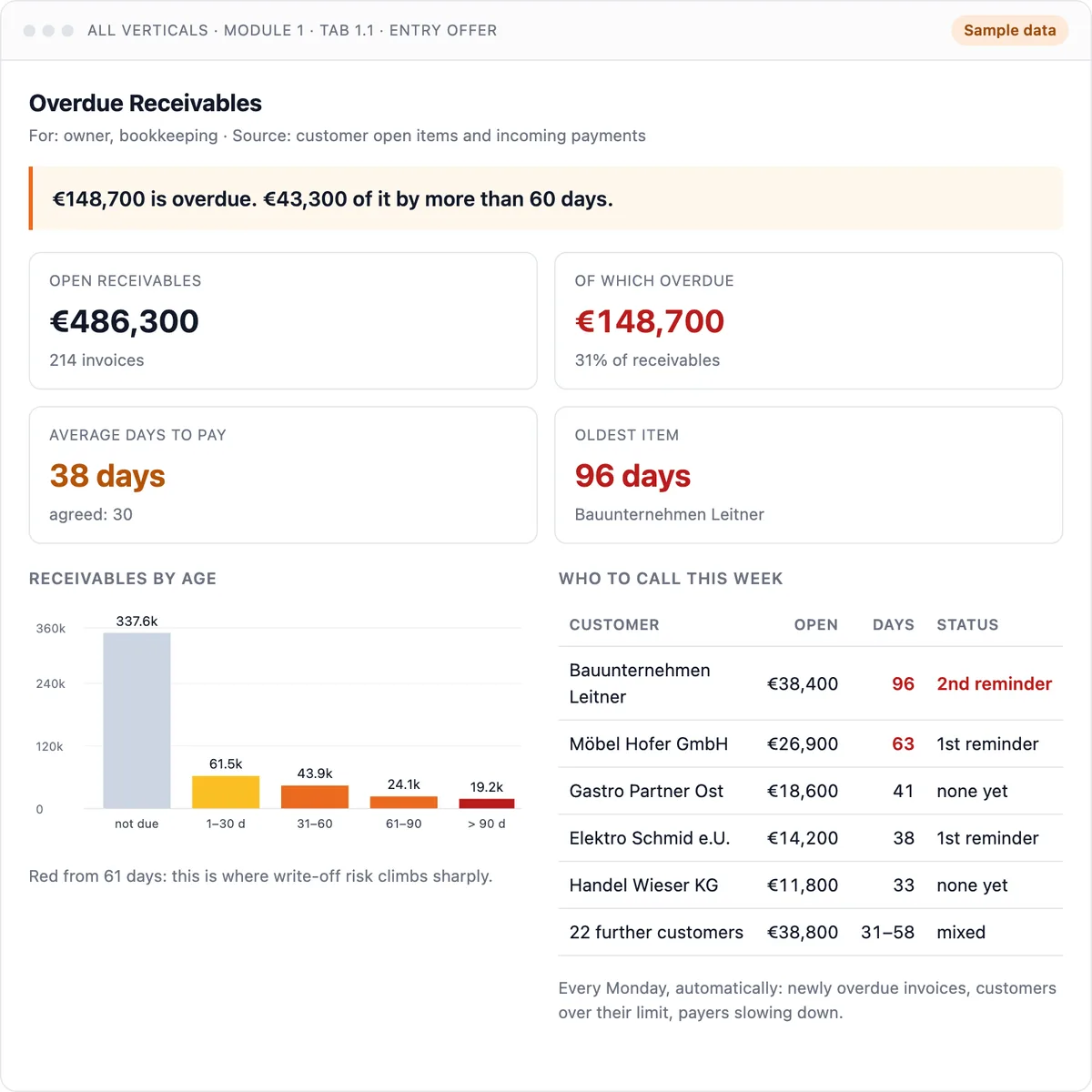
Which customers are overdue, who is slipping past their agreed terms, and where the write-off risk sits.
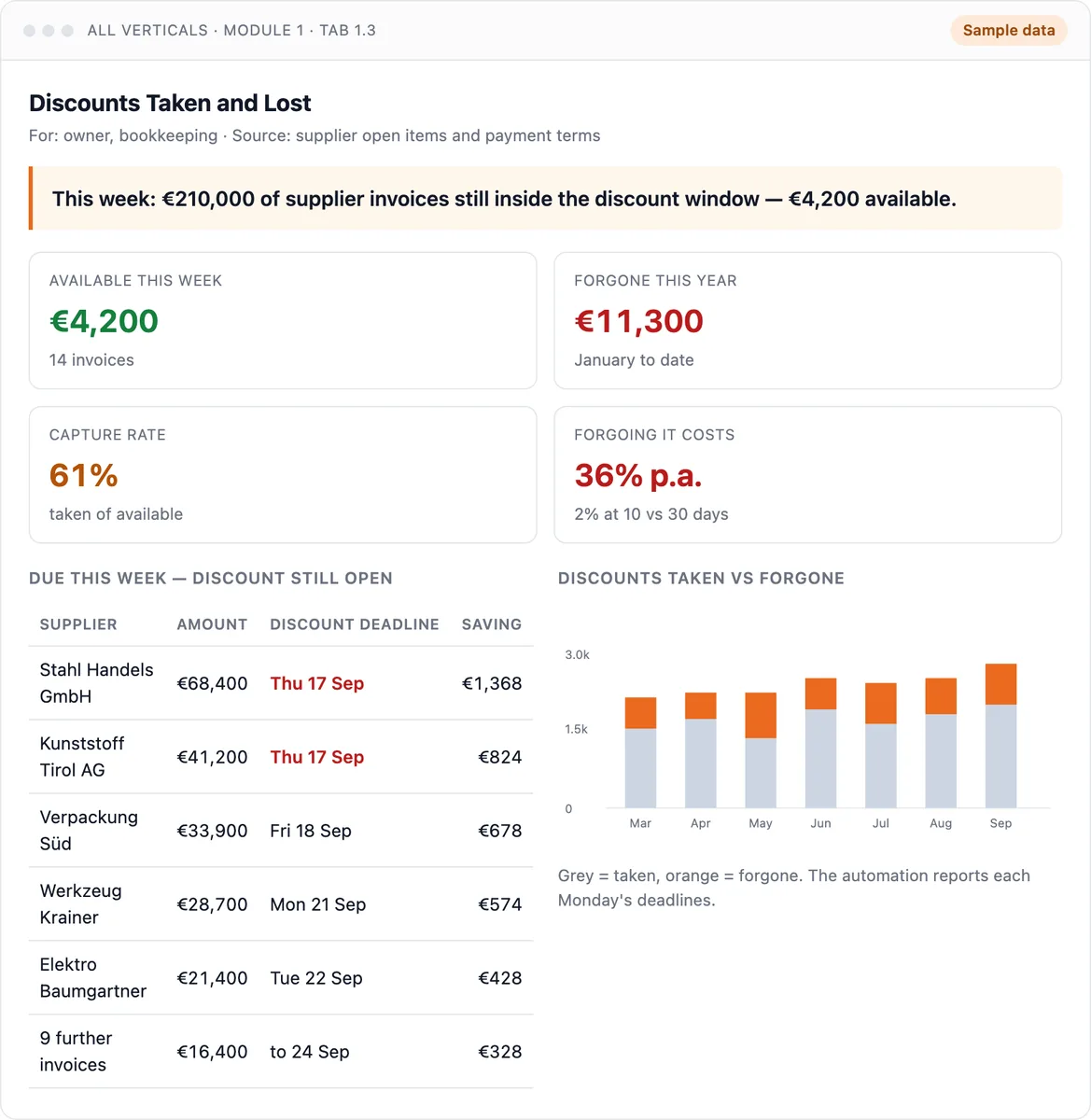
Which supplier invoices still carry an early-payment discount this week, and what it is worth.
Stock that has not moved in a year. Jobs that lost money. Hours worked and never invoiced.
Overdue receivables, every Monday.
Every open customer invoice by age, who is past their agreed terms, who is slowing down. It needs only the open-items list from your accounting.
Your data stays yours.
"Which customers pay slower than last year?" The assistant answers from your own figures and shows the rows behind every number.
Daily checks read your data and report only what changed: an invoice just overdue, a discount expiring this week, an item a year without moving. Set the question once.
Beetl runs on European infrastructure in Germany, not on a US cloud. Your data sits in storage that belongs to you.
Beetl works on a copy and never changes anything in your accounting or ERP. Your books stay as they are, and access can be withdrawn at any time.
No per-user pricing. Owner, bookkeeper and sales lead look at the same figures.
One export, then a straight answer.
The free data check
Send us one export from the system that matters most to you. We tell you what it holds, how clean it is, and which dashboard would pay for itself first.
It costs nothing, and it is also how we find out whether your data can carry the dashboards you want.
Your own question
If the dashboard you need is not in the catalogue, we build it for your business case: margin per machine hour, the branch comparison, the report your bank asks for.
What you are left with
A maintained pipeline behind the numbers, not a report somebody rebuilds. The definitions are written down as SQL rather than held by one person, and the source rows stay attached to every answer.
What it costs
From €250 a month, plus a one-off setup from €1,500. Priced by the systems we read and the dashboards you use, never by users.
Dashboards are €75 a month each, and the first ones are built inside the setup. We quote the whole thing after the data check, when we know what your data actually holds.
Public digitalisation grants cover part of a setup like this in many regions. Tell us where you are based and we prepare the paperwork.
Seventeen dashboards. Each one built from an export you already have.
Every one reports on Monday what changed since last week. Filter by the kind of business you run. Three dots means the effect is usually five figures a year or a large one-off cash release.
17 dashboards
Some need one more export, such as a stock list or hours per job. The data check tells you which apply to your data.
Questions we get before the data check
What counts as a source?
Do we have to change anything in our systems?
Where does the data sit?
Do we pay per user?
What does a dashboard cost?
What is the free data check?
Worth a look?
Send us one export. We tell you what it holds, how clean it is, and which dashboard pays for itself first. It costs nothing.
Send us one export.
Name the system it came out of and what you wish you could see. We come back with what the export holds and which dashboard would pay for itself first. Vienna-based, hosted in the EU.