10 November 2026 · 12 min read
Should I turn my heating on? I asked Germany's gas storage data
Germany began winter with its emptiest gas storage since 2011. I joined 3 public data sources in Beetl to find out why, and what a hard winter would cost.
 Ray KamedaCo-Founder & Chief Product Officer
It's November in Berlin and 1°C when I get up, and I still haven't turned the heating on. Partly to save money. Partly because I'd read that Germany's gas storage is low this year, and some stubborn part of me figured every radiator counts.
Update, 12 November 2026: my friend Markus asked what this means for his heating bill. The tracker now shows household gas and heating oil prices, and the bill section has the numbers.
At some point I got curious whether that was a real worry or just a headline. Most coverage quotes one number, the national fill level. I wanted the sites behind it, so I connected 3 public sources on Europe's gas system and joined them on our Beetl platform. That's about 3 million records.
Three public sources joined in Beetl
GIE AGSI+ publishes daily storage levels for every EU country and every storage site back to 2011. GIE ALSI does the same for LNG terminals. The ENTSOG Transparency Platform has the pipeline flows and the points where each storage site connects to a national grid. Connectors collect all 3 into Beetl every night, and data pipelines on Beetl turn them into the charts below.
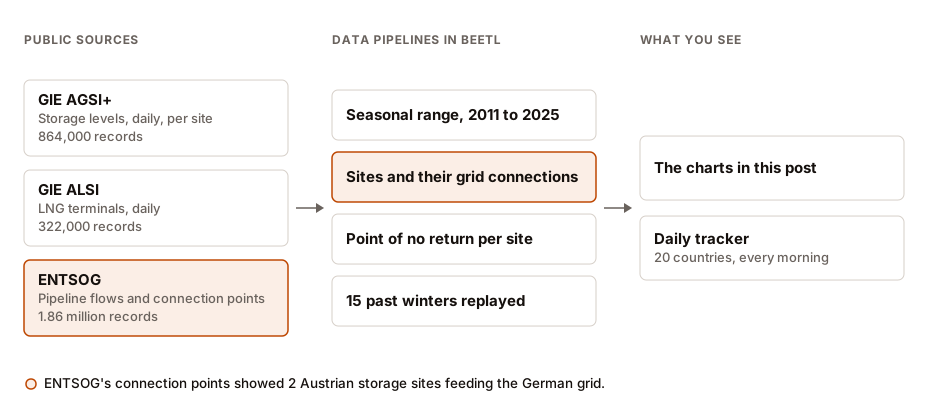
The join that changed the story was the last one. Storage data is reported by country, so Germany's numbers leave out 2 large storage sites in Austria, Haidach and 7 Fields. ENTSOG's connection points show that both feed the German grid. They matter in Bavaria, and they only appear once the sources are joined.
Germany's lowest November start since 2011
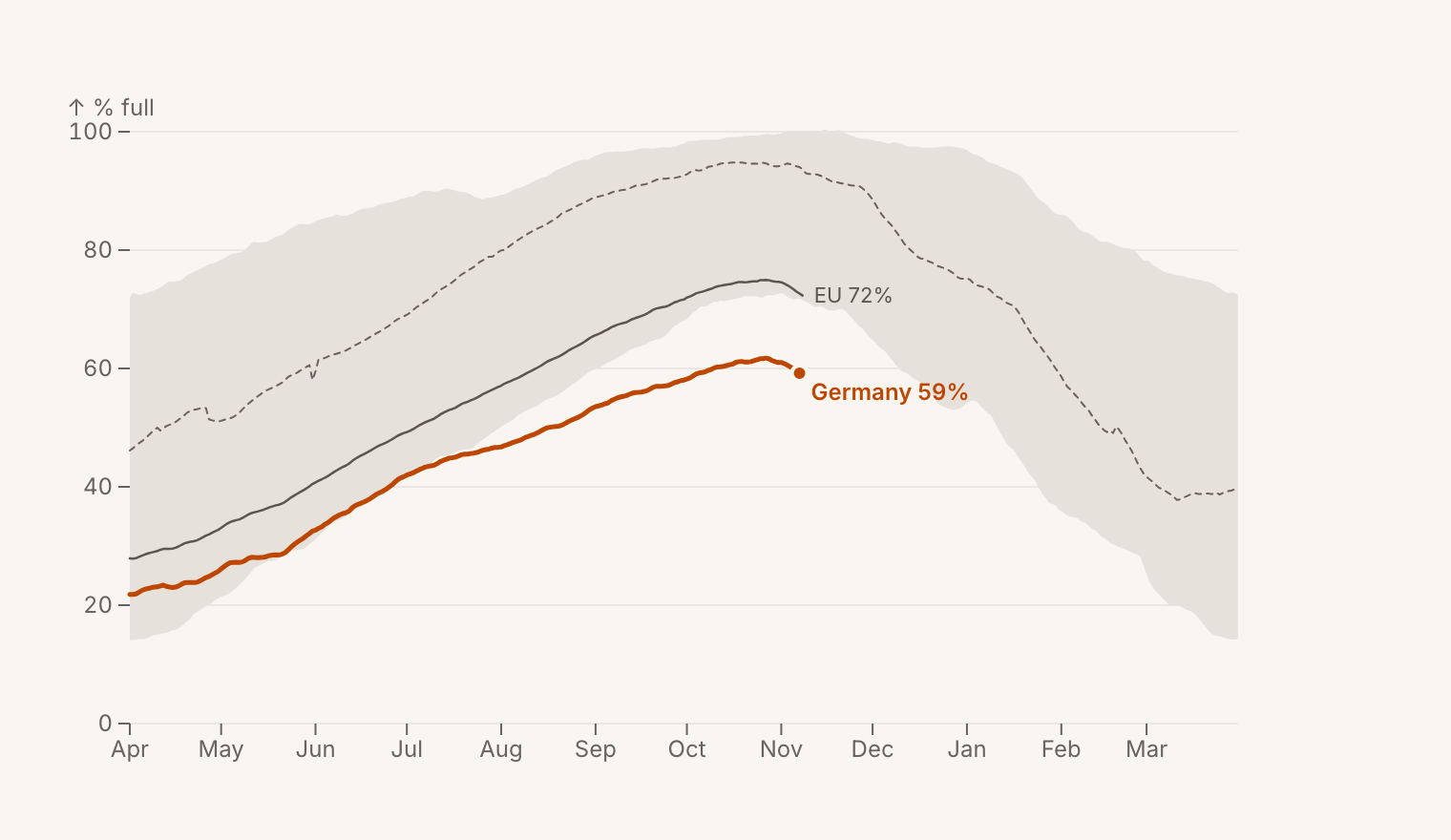
Germany was 61% full on 1 November. Last year it was 75%, the year before 98%, and the lowest 1 November before this year was 73%. On 8 November the EU as a whole was 72% full, and only Slovakia and Latvia were emptier than Germany within the EU.
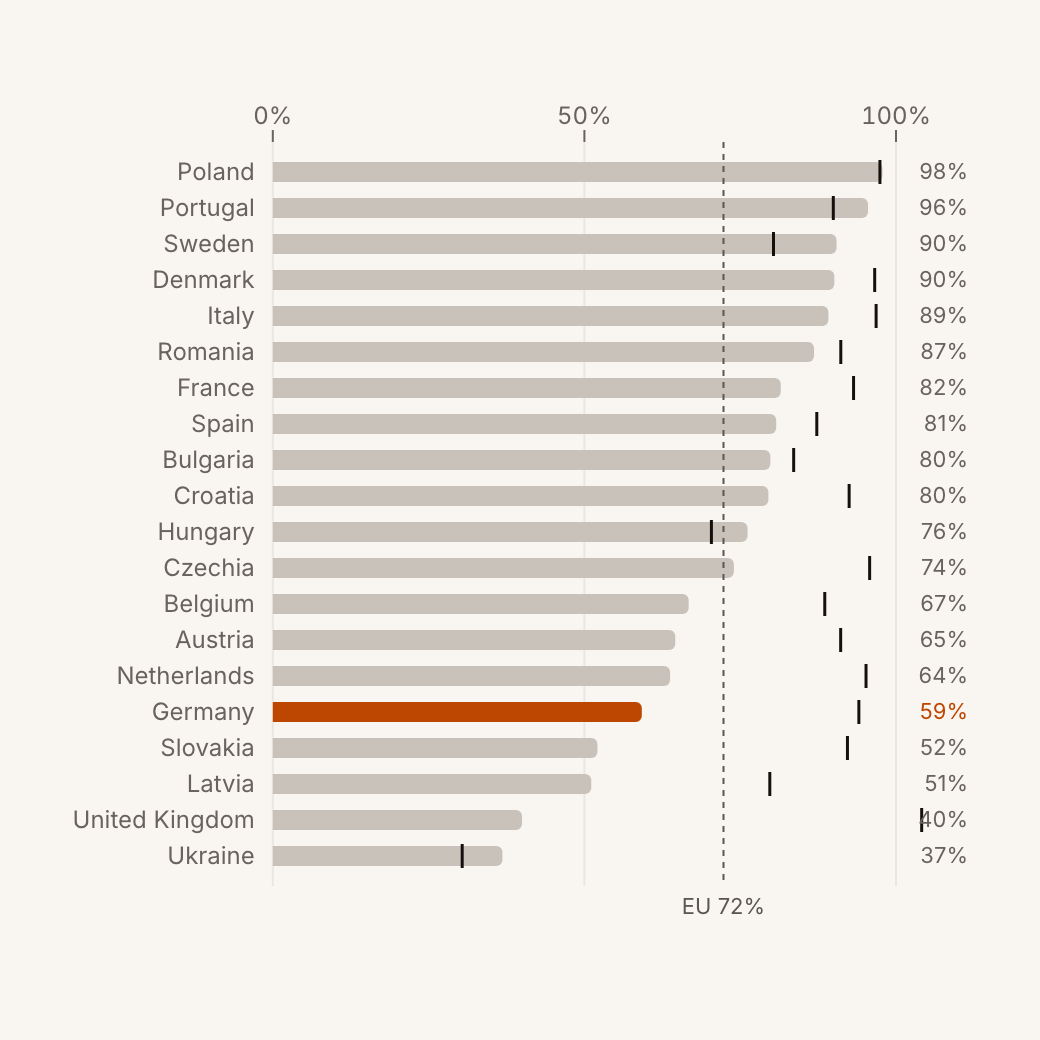
Nobody had a reason to fill it
Naively, I assumed this was about the Strait of Hormuz. It mostly isn't. Germany imports no LNG from the Gulf at all, according to the government's reply to parliament. Hormuz matters through the price, because Asia now bids harder for the same Atlantic cargoes Europe buys.
The bigger reason is that storing gas stopped paying. Normally gas is cheaper in summer, so traders buy it, store it and sell it in winter. This year summer gas cost more than winter gas, so every MWh put into storage lost money. By the start of April, German traders had booked only about 63% of the country's storage capacity, Argus reported, and nobody had a reason to book more.
Some countries have a buyer of last resort for exactly this. The Netherlands told its state company EBN to fill storage and backed it with a €21.6 billion credit line (OIES). Germany went the other way. It scrapped the storage levy that funded state purchases in January and expected that its market operator wouldn't need to buy any gas. In September the ministry finally asked state-owned SEFE to buy "in small steps": about 3% of capacity by mid-December. And Germany started from a low point, with storage only 22% full on 1 April.
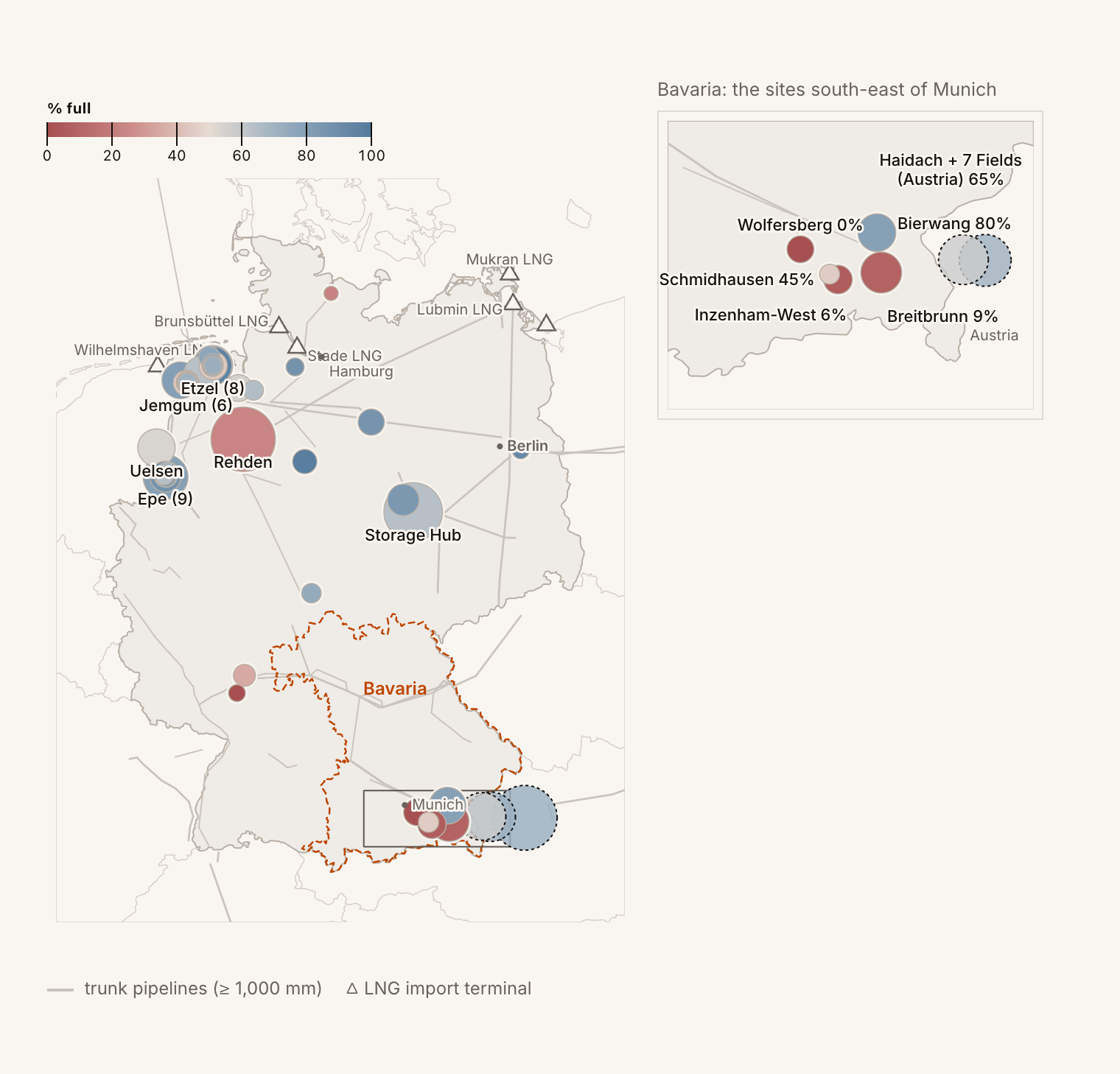
Germany has 46 storage sites, and on 7 November about half of its empty space sat in just 4 of them. Rehden alone had 27 TWh free. In January, a wave of YouTube videos used the same site list to claim German storage was collapsing (Cleanthinking debunked them), showing small sites as percentages without their volumes. So this map sizes every site by capacity.
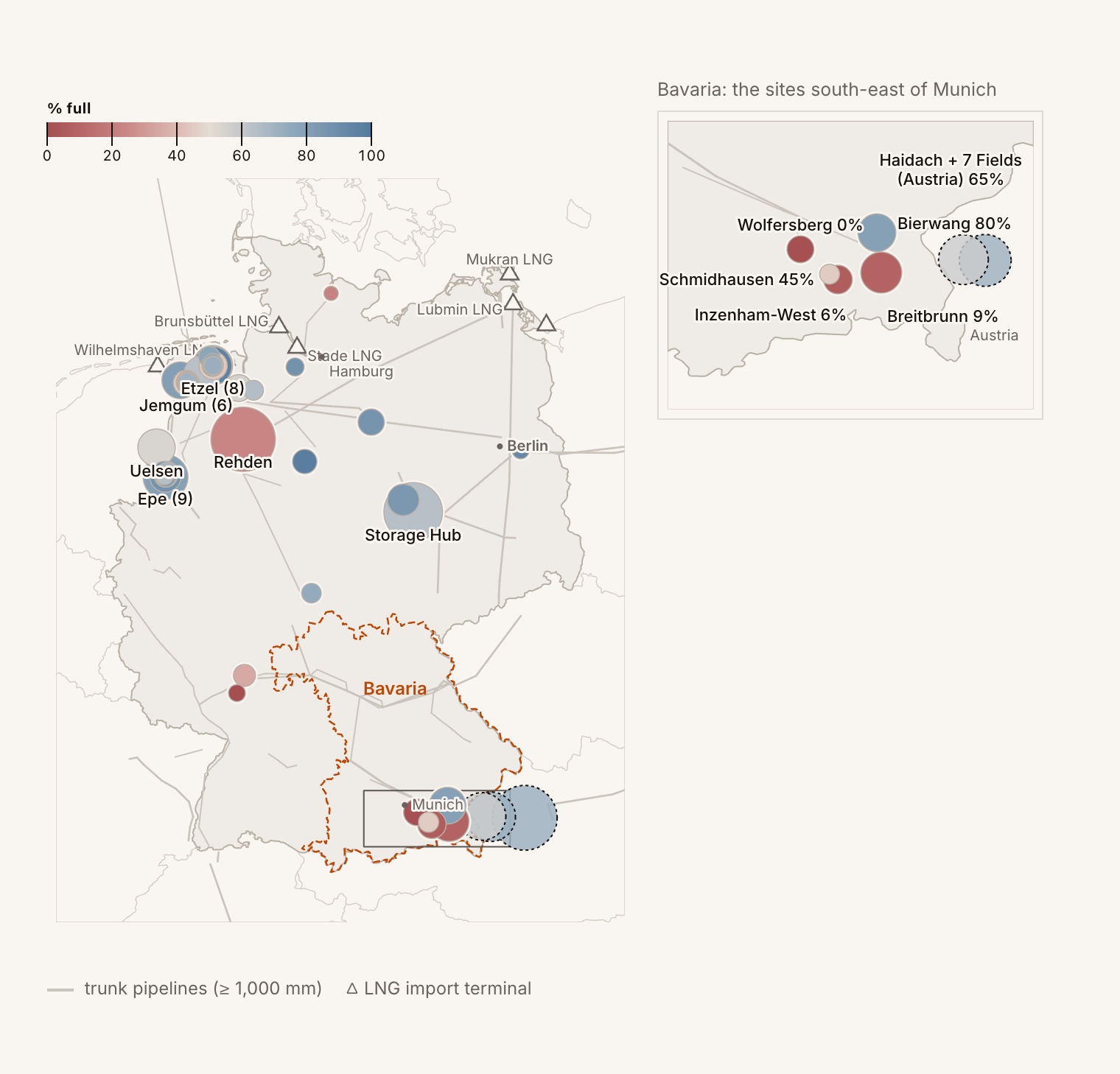
Three fields near Munich ran out of time this summer
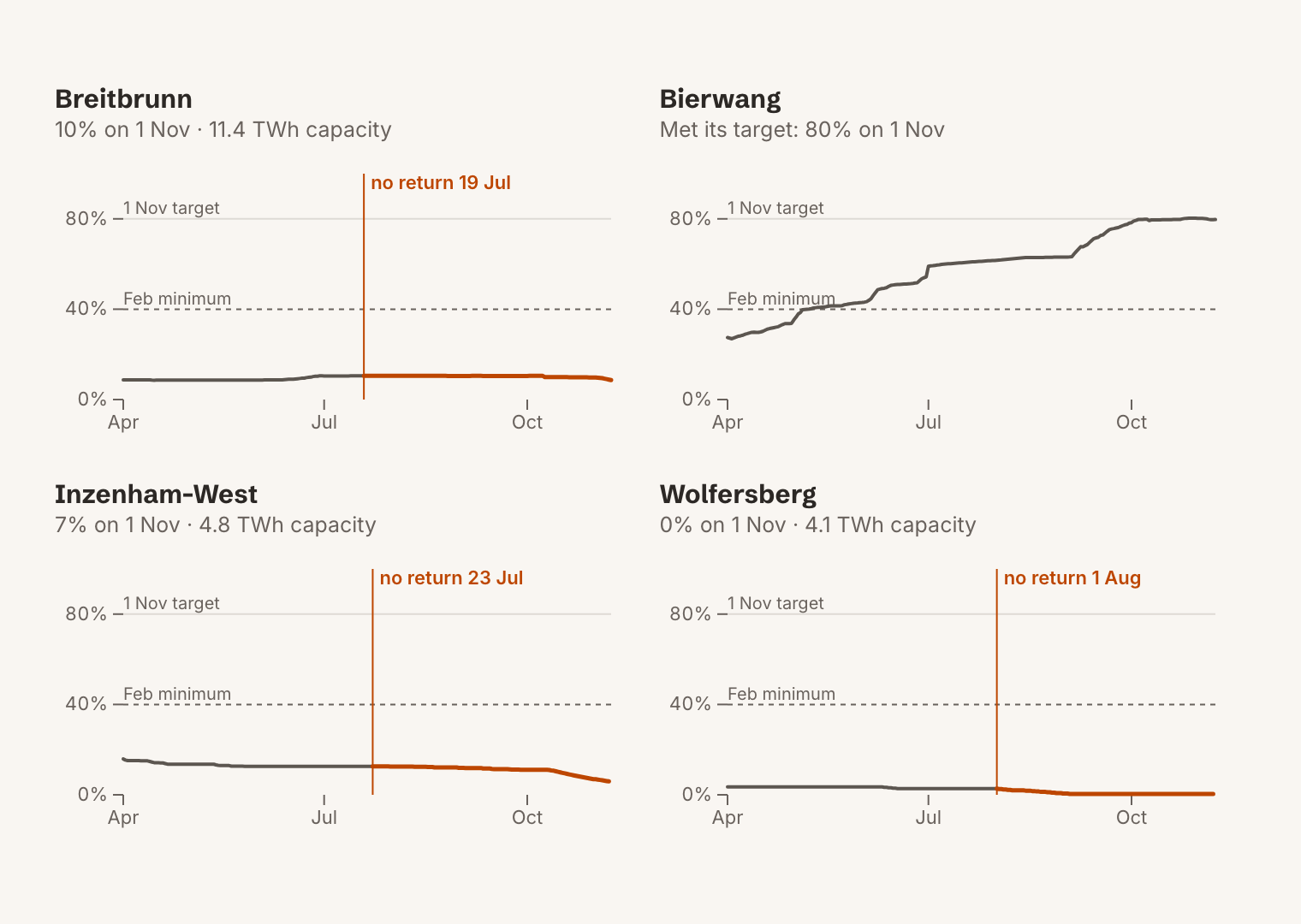
Munich papers had already reported how empty the Bavarian sites were, so I asked a different question: when did filling them to their legal target of 80% by 1 November become impossible? Working backwards from each site's fastest past injection rates gives a point of no return.
| Site | Full on 7 November | Point of no return |
|---|---|---|
| Breitbrunn | 9% | 19 July |
| Inzenham-West | 6% | 23 July |
| Wolfersberg | 0.4% | 1 August |
The government confirmed the shortfall in its reply to parliament on 3 September, 5 to 7 weeks later. Missing the target costs nobody anything, though. The storage rule (§ 35b EnWG) carries no penalty, and the Bundesnetzagentur says meeting even the 1 February targets is "not strictly necessary" for secure supply. The target works as an early warning, and in Bavaria the warning was visible in July.
Bavaria isn't empty, either. Haidach and 7 Fields, the 2 Austrian sites on the German grid, were 58% to 72% full on 7 November.
What a hard winter would mean for your bill
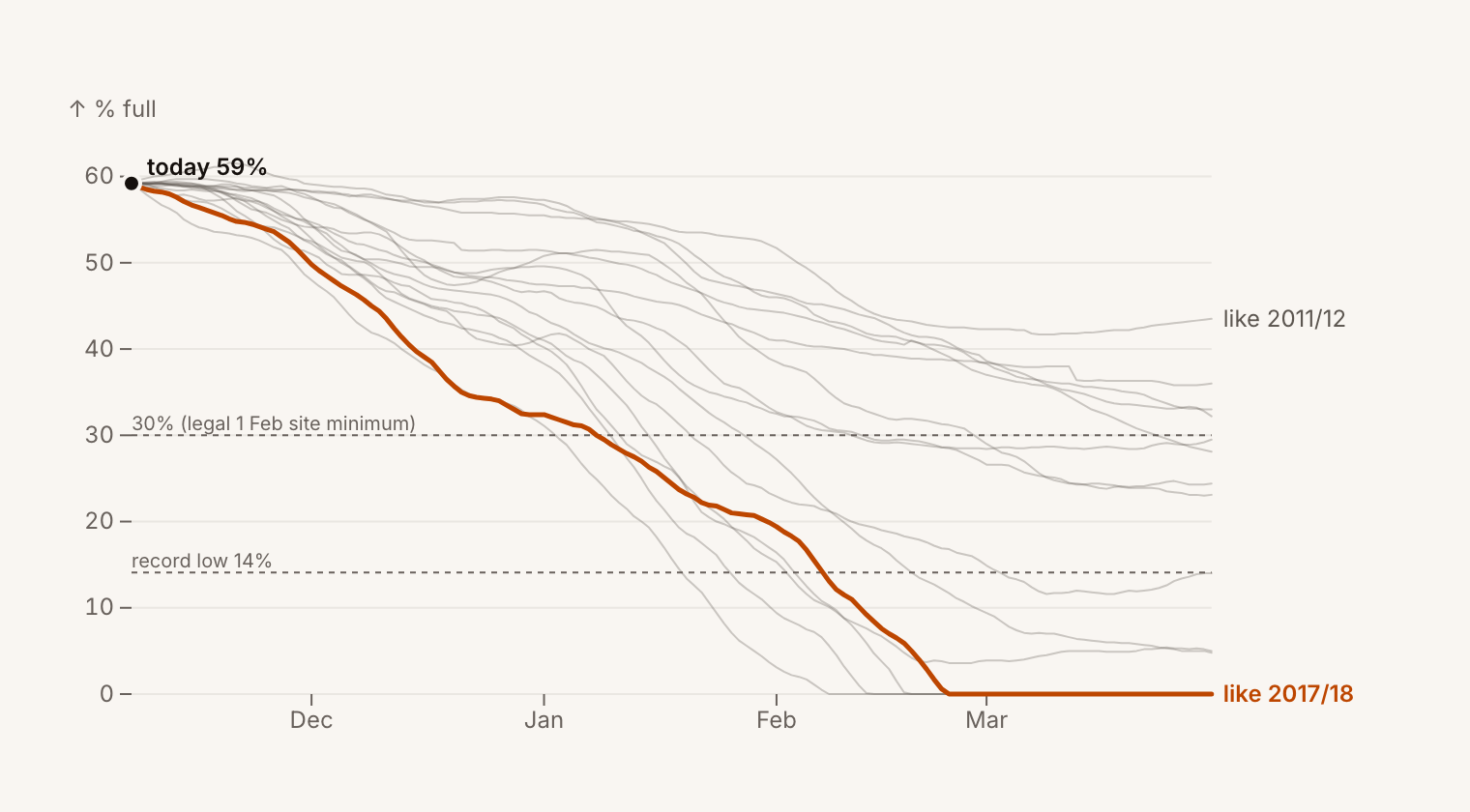
I didn't want to write a scare piece, so I tested how likely Germany is to run out of stored gas before spring. I took Germany's storage on 7 November and drew it down at each past winter's daily withdrawals.
In 7 of those 15 winters, Germany would fall below its lowest level since 2011 (14%). In 4, storage alone wouldn't last until the end of March. The hardest case, 2017/18, needs 45 TWh more than storage holds. Germany's LNG terminals have about 92 TWh of unused capacity until 31 March, so on paper even that is covered.
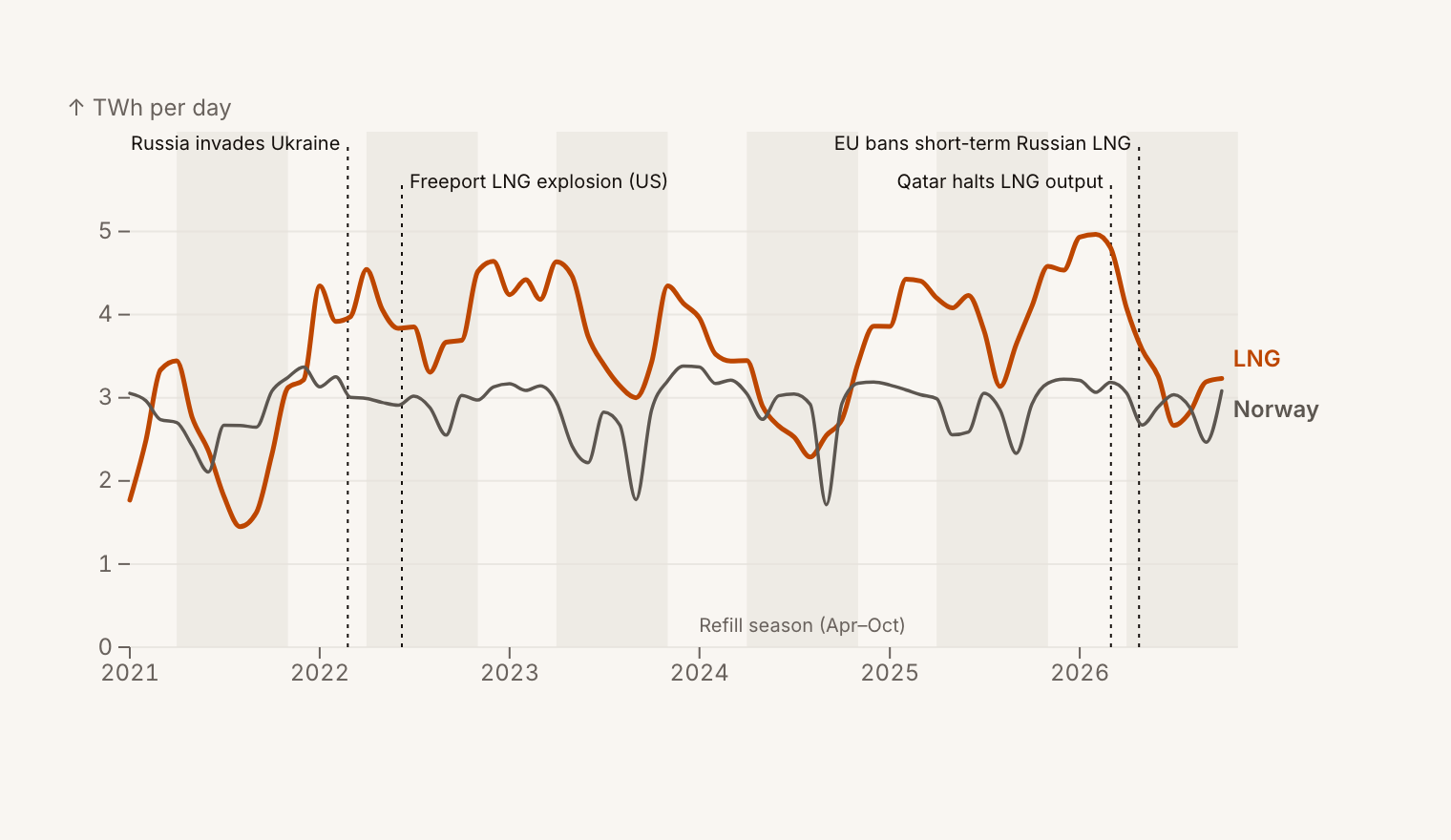
The catch is that someone has to buy those cargoes. LNG arriving in the EU fell from about 4.9 TWh a day in the first quarter to 2.7 TWh in July, after Qatar stopped production in March, right in the middle of refill season. The 2024 dip had a different cause: Europe came out of a mild winter with storage almost 60% full that April, so it needed less. This year storage was 28% full on 1 April, and LNG fell anyway.
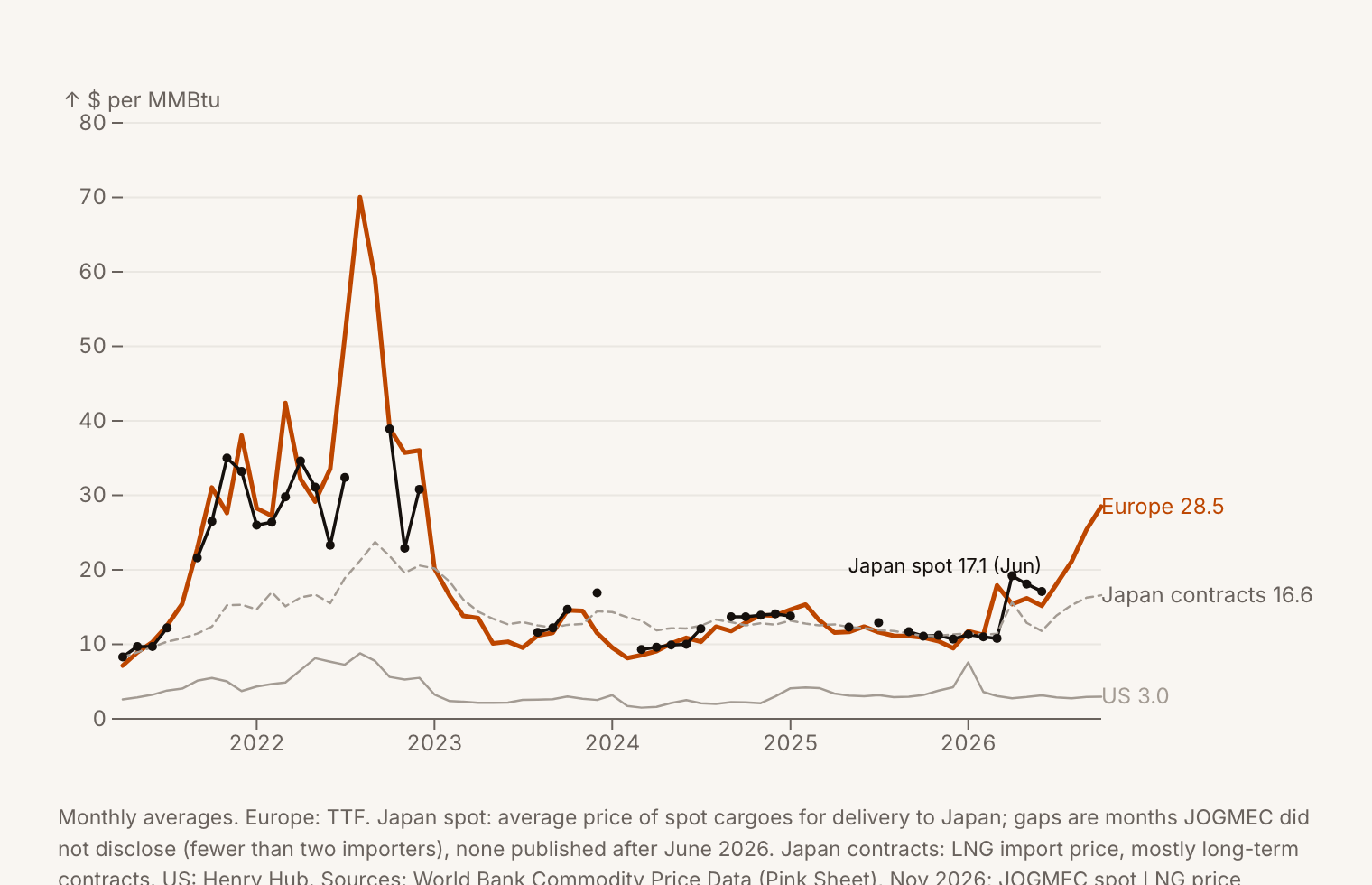
Cargoes came back once European prices climbed, from about $15 per MMBtu in June to $28.5 in October, almost 10 times the US price. Asia bids for the same ships: from April to June, spot cargoes for Japan sold a few dollars above Europe (JOGMEC). So the gas most likely comes, at a price.
That price reaches households slowly. New gas contracts cost about 14 ct/kWh, Verivox reports, and only 42% of that is procurement, margin and sales. The rest is network fees, taxes and levies that don't follow the market. Suppliers also buy months ahead, so a wholesale spike arrives later. In October, Verivox's CEO expected increases of up to 20% for existing customers by the turn of the year. For a family in a house paying about €2,400 a year, that is close to €500 more.
Eurostat shows how slowly bills move. German households paid 6 to 7 ct/kWh for gas before 2022 and about 11.6 ct in September 2026 (our estimate). That's the average across all contracts, so it sits below Verivox's 14 ct for new ones.
Heating oil has no such delay. It went from €0.93 to €1.72 a litre this year (EU Weekly Oil Bulletin), about 40% more than gas per kWh, and it supplies a quarter of German home heating (Eurostat).
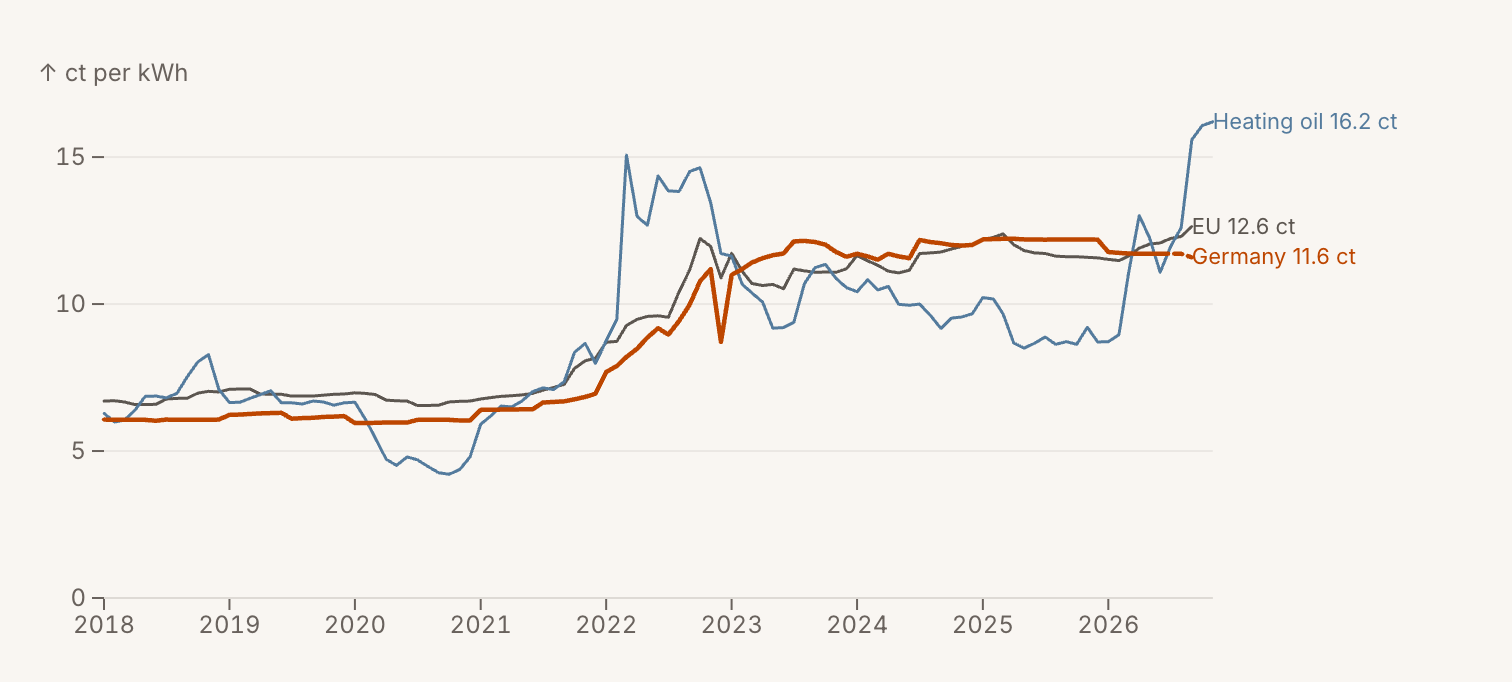
If Verivox's 20% reaches existing contracts, the average would be about 13.9 ct, more than Eurostat has recorded for Germany since 2007.
That's the mild case. In a cold January, Italy's energy ministry expects wholesale prices of €150–180/MWh, roughly double October's level and the kind of price that makes big users cut back. Few households would feel that straight away, but it would land in next year's contracts. Next summer's refill looks harder still, because the price curve still pays traders to sell now. Winters don't repeat, so treat all of this as an estimate.
As for my radiator: Germany will probably get through this winter, it just depends on ships arriving, and I'll pay for them either way. I'm turning it on. Maybe one notch lower.
How I built it
The tracker reads the same pipeline outputs as this post, and it refreshes each morning. Next week I'll write up how it came together: getting 3 public sources to update on their own, turning a Germany-only analysis into a Europe-wide one, and keeping a public tracker fast without hammering the database behind it.
FAQ
Why is Germany's gas storage so low this winter?
Mainly because storing gas stopped paying. In 2026, summer gas cost more than winter gas, so buying gas to store it lost money, and by April traders had booked only about 63% of Germany's storage capacity. Germany also had no buyer of last resort: it scrapped the storage levy that funded state purchases in January 2026, and it expected its market operator would not need to buy any. Storage was 61% full on 1 November, the lowest since records began in 2011.
Will my gas bill go up this winter?
Probably, with a delay. Procurement, margin and sales make up about 42% of a German household gas price, according to Verivox, and suppliers buy ahead, so wholesale moves reach bills months later. Verivox's CEO expected increases of up to 20% for existing customers by the turn of the year. A cold January could push wholesale prices to about double October's level, which would mostly show up in next year's contracts. Eurostat puts the German household average at about 11.6 ct/kWh (our estimate for September 2026), and heating oil is up about 85% this year.
Is the Strait of Hormuz the reason German storage is low?
Only indirectly. Germany imports no LNG from the Gulf. Qatar's production halt in March 2026 and the near-closure of Hormuz cut global LNG supply, which raised prices and pulled cargoes toward Asia. LNG arriving in the EU fell to 2.7 TWh a day in July 2026, 30% below July 2025.
What is a storage site's point of no return?
It is the last day on which a storage site could still reach its fill target if it injected gas at its fastest historical rate. We calculate it from each site's past injection rates at every fill level, working backwards from 1 November. For the Bavarian sites Breitbrunn, Inzenham-West and Wolfersberg it fell between 19 July and 1 August 2026.
Will Germany run out of gas this winter?
Probably not, but it may get expensive. Replaying Germany's storage on 7 November through 15 past winters, Germany falls below its lowest level since 2011 in 7 cases, and storage alone would not last until the end of March in 4. Even the hardest case fits within Germany's unused LNG terminal capacity, so the risk is the price of the extra cargoes, not empty pipes. This is an estimate, not a forecast.